Zhenjiang! A Thousand Years of Mist and Rain, Endless Views for the Eyes
The boats on the canal drift north and south, winding a thousand turns before reaching the Yangtze. From Beigu Tower you gaze toward the old Xijin Ferry, and the scenery stretches beyond what the eyes can hold. The drizzle over Jiaoshan falls softly across the Jiangnan landscape—when will the bright moon guide me home? The wind and waves stretch for miles; Jinshan's waters meet the sky, like a lotus blooming in the middle of the river. My impression of Zhenjiang always began with its universally known vinegar, but ever since I heard the song "Returning Home" by the Good Sister band, I've wanted to visit this small thousand-year-old city that sits so close to Yangzhou. It may not be as famous in the misty Jiangnan region, but it carries just as much history and romance. I wanted to see with my own eyes the Xijin Ferry of endless views from the song, and the famous "Three Treasures of Zhenjiang"—Jiaoshan, Jinshan, and Beigu Mountain.
Itinerary
Day 1: Afternoon – Jiaoshan
Day 2: Morning – Beigu Mountain; Afternoon – Jinshan
Day 3: Morning – Xijin Ferry Museum; Afternoon – the old street
Zhenjiang isn't a big city, and the scenic spots are close to each other. If you're in a hurry, a day or two is enough to cover everything I've mentioned. But spring in Jiangnan is so beautiful that I preferred to take my time, savoring each place slowly, and so my trip stretched into nearly three leisurely days.
Treasure One of Zhenjiang: Jiaoshan
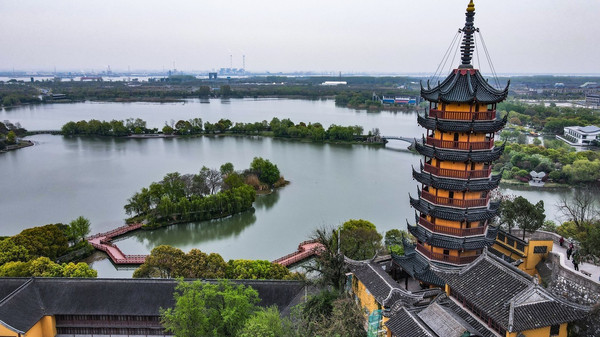
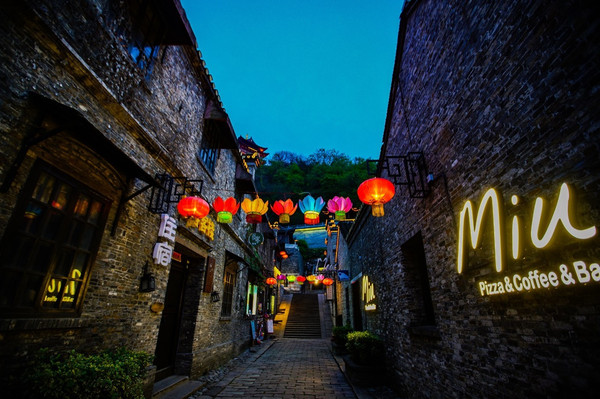
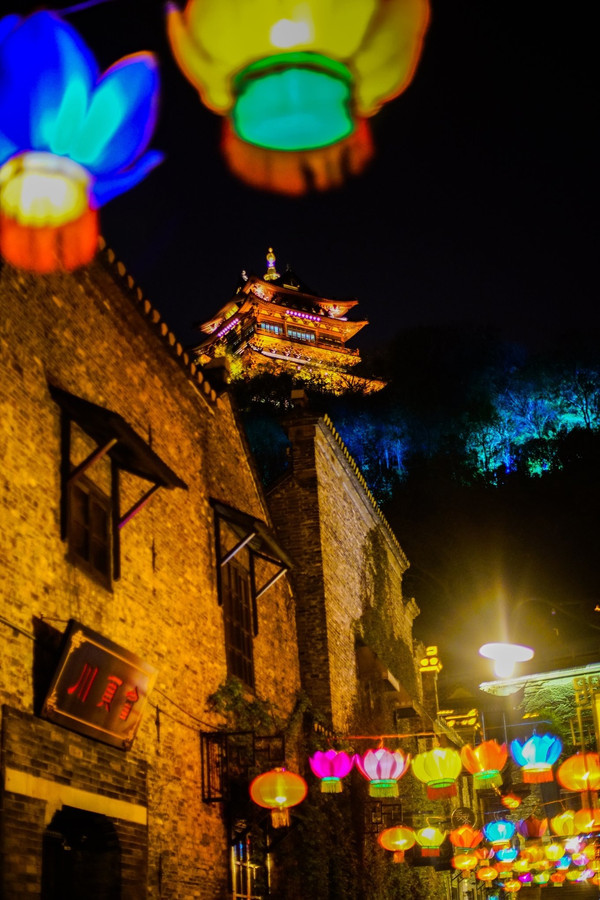
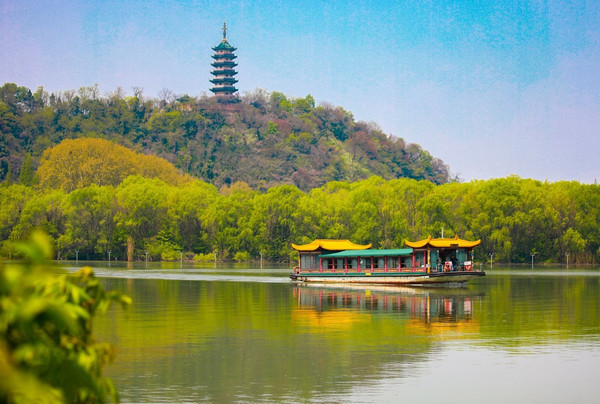
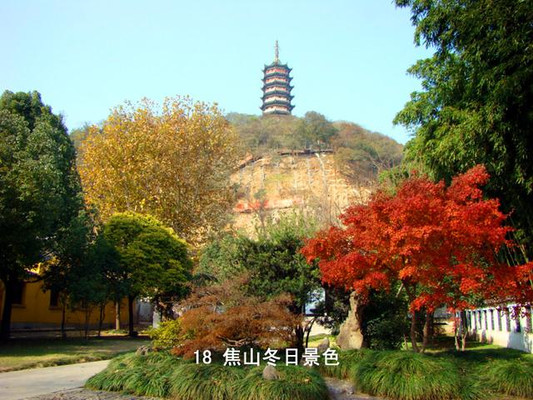
I arrived at Xijin Ferry around noon on the first day. I highly recommend staying here—there are plenty of charming hotels and guesthouses, it's convenient for reaching the sights, and you can wander around at night. I'll share more about that later. For now, I dropped off my luggage and headed straight to my first stop, Jiaoshan. Jiaoshan is a small island in the middle of the river, with the Wanfo Pagoda at its summit serving as its landmark. After entering the scenic area, you need to take a ferry across.
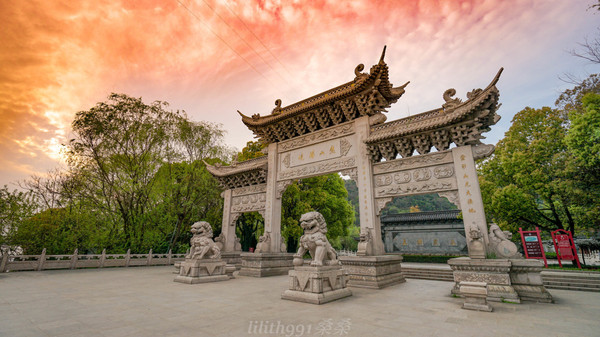
Once off the boat, the first thing that catches your eye is Dinghui Temple on Jiaoshan. Originally called Puji Zen Temple, it was first built during the Xingping era of the Eastern Han dynasty, over 1,700 years ago. In the Tang dynasty, a disciple of the great master Xuanzang came to the mountain and built the Grand Buddha Hall. In the Song dynasty it was renamed Puji Zen Monastery, and in the Yuan dynasty it became Jiaoshan Temple before being destroyed by fire. During the Xuande reign of the Ming dynasty, a monk named Jue Chuxin rebuilt it. It wasn't until Emperor Kangxi of the Qing dynasty visited Jiaoshan during his southern tours that the temple was renamed Dinghui Temple, a name it still carries today, and it retains its Ming-dynasty architectural style.
Two ginkgo trees stand in front of the Grand Buddha Hall, now over four hundred years old. The one inside the temple grounds is tall and sturdy, adding an air of antiquity to the temple. The ceiling of the Grand Buddha Hall is carved with dragons and painted with phoenixes, held together entirely by small wooden pieces without a single nail. The design is exquisite, with flying eaves and bracketing that are rarely seen in China. Combined with the three magnificent golden Buddha statues, the hall radiates grandeur. A delicate ever-burning lamp hangs high in the air, while incense smoke curls up from the purple bronze censer, giving the whole hall a solemn, serene, and otherworldly atmosphere.
The Forest of Steles on Jiaoshan, also known as Baomo Pavilion, can be reached by crossing a small bridge from Guanlan Pavilion and passing through a rockery. There, nestled beneath the ginkgo trees, stands Baomo Pavilion. This was originally the site of the Ziran Hermitage, Xianglin Hermitage, Yufeng Hermitage, and Haiyun Hermitage. The stele forest houses over four hundred stone inscriptions from various dynasties—second in number only to the Forest of Steles in Xi'an, making it the largest in Jiangnan. These steles are set into the walls of winding corridors and pavilions, covering calligraphy, art, historical records, tomb epitaphs, and stone carvings. Among them is the stele of Master Wei, erected in 677 AD during the Tang dynasty, hailed as a "fine piece of early Tang craftsmanship," with its complete text and neat, forceful script making it a rare Tang-dynasty relic. Surrounded by bamboo groves is another exquisite square courtyard called Biefeng Hermitage. The name "Biefeng" means the ridge is distinct from the main peaks of Jiaoshan (the eastern and western peaks). The great Qing-dynasty painter, calligrapher, and poet Zheng Banqiao once studied here, which is why Biefeng Hermitage became famous.
The Imperial Stele Pavilion is a square, wooden, antique pavilion with glazed tiles. Inside stands a stone stele bearing the poem "Song of Visiting Jiaoshan," composed by Emperor Qianlong during his first southern tour, with the reverse side inscribed with "Song of Visiting Jiaoshan, Matching the Previous Rhyme" from his third visit. Because the emperor's own handwriting was carved into the stone and a pavilion built over it, it came to be called the Imperial Stele Pavilion. In the poem, Qianlong compares the scenery of Jinshan and Jiaoshan, concluding that in terms of natural landscape, Jiaoshan surpasses Jinshan. The poem reads: Jinshan resembles Xie An, with silk and flute music intoxicating the ornate halls; Jiaoshan resembles Wang Xizhi, lying carefree on the eastern bed with his belly exposed; one cannot be called the younger brother, the other the elder—both make their names heard.
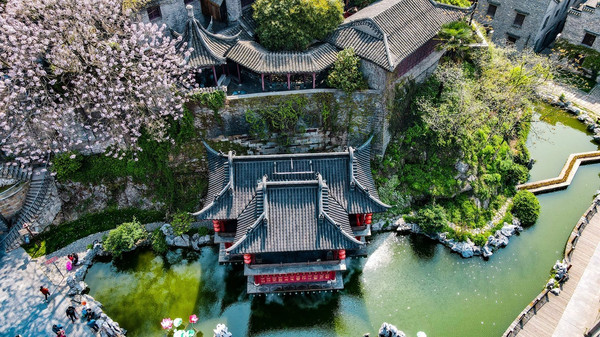
Past a row of maple trees, a delicate, elegant courtyard comes into view. A towering, graceful ancient wingnut tree over four hundred years old stands there. This was the temporary palace where Emperor Qianlong stayed during his southern tours, and it is a classic example of a Jiangnan garden. The palace is a two-story building. Over fifty years ago, there was no sandy beach in front of the pavilion; the waves crashed against the shore outside, surging and rolling, which is why it was named Guanlan Pavilion (Pavilion for Viewing Waves).
Because of this imperial residence, the walk along the way is dotted with historical sites and rich cultural atmosphere.
The Wanfo Pagoda is a Ming-Qing-style pagoda built in the Jiangnan tradition. It stands atop Jiaoshan's summit, reaching 42 meters in height with an elevation of 70.4 meters above sea level, covering a floor area of 583 square meters. As the highest point on the island, it's visible from everywhere.
The pagoda has seven stories with eight sides, featuring a celestial palace above and an underground palace below. The courtyard is laid out with front and rear gate halls, left and right stele corridors, and side rooms, arranged in a pleasingly irregular fashion that complements the pagoda beautifully.
Tips:
Address: No. 83 Dongwu Road, Jingkou District, Zhenjiang
Opening hours: 7:30–17:30
Admission: 60 yuan
If you also plan to visit Beigu Mountain and Jinshan, you can buy the "Three Mountains Combo Ticket" for just 120 yuan, which is cheaper than buying separately.
Treasure Two of Zhenjiang: Beigu Mountain
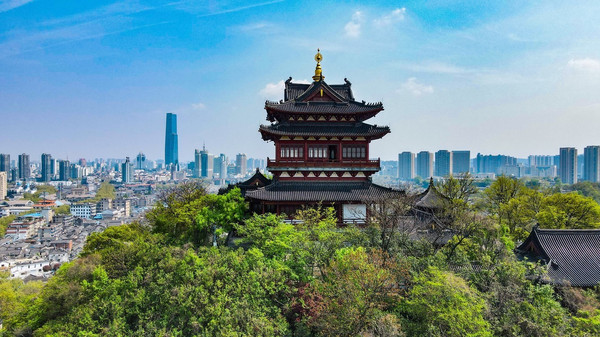
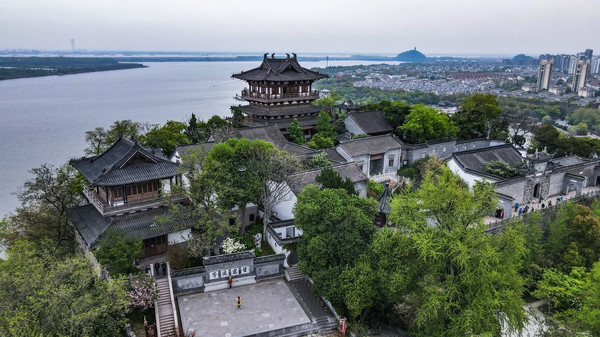
Beigu Mountain sits on the bank of the Yangtze River, 58.5 meters high, consisting of three parts: the front peak, middle peak, and rear peak (the main peak). The rear peak juts straight into the river like a peninsula, its terrain extremely steep and perilous. Climbing Beigu, you can see Jinshan to the west and Jiaoshan to the east, the three mountains forming a triangular formation.
April is the prime time for spring scenery. The late cherry blossoms hang heavy on the branches, absolutely beautiful.
Beigu Mountain is also a mountain famous for poetry and prose. Throughout history, countless literary figures such as Liu Yong, Su Shi, Lu You, Xin Qiji, and Chen Liang have climbed this mountain, leaving behind many well-loved poems and essays.
A mountain's fame doesn't depend on its height, but on the buildings upon it. Legend has it that when Liu Bei came to Ganlu Temple for his marriage, he saw Beigu Mountain standing majestically by the river with wide-open water and sky and couldn't help but exclaim, "This is the finest landscape under heaven!" Although history has proven that Liu Bei's marriage has nothing to do with this mountain, the tale of the Three Kingdoms has made it famous both at home and abroad. Every historic site on the mountain today is tied to that story.
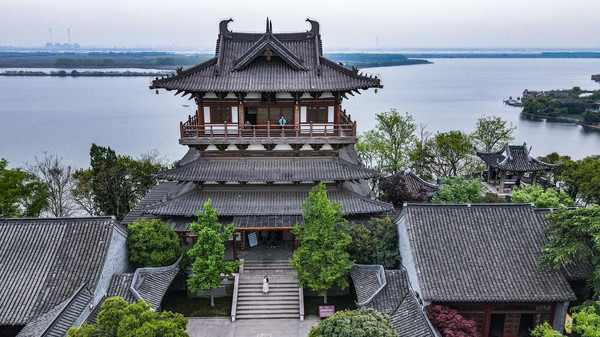
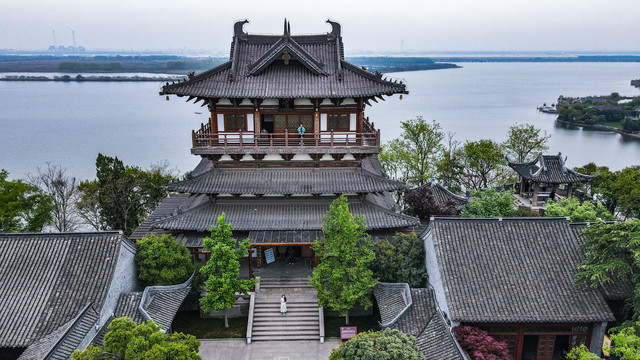
The mountain's fame lies not in its height but in its towers. From the top-floor corridor, you can look out over the Yangtze in all directions. "Where to view the divine land? The sights fill the eyes from Beigu Tower. How many rises and falls through the ages? Endless, the Yangtze rolls on." When I was young, I read Xin Qiji's poem "