Jiangsu Travel: A Winter Visit to Zhenjiang's
For people living up north, where's a good place to travel in winter? Hainan goes without saying, but it's a relatively long haul. In December 2009, right in the thick of winter, this reporter headed to Zhenjiang in Jiangsu Province and found it a surprisingly good choice even in the bitter cold.
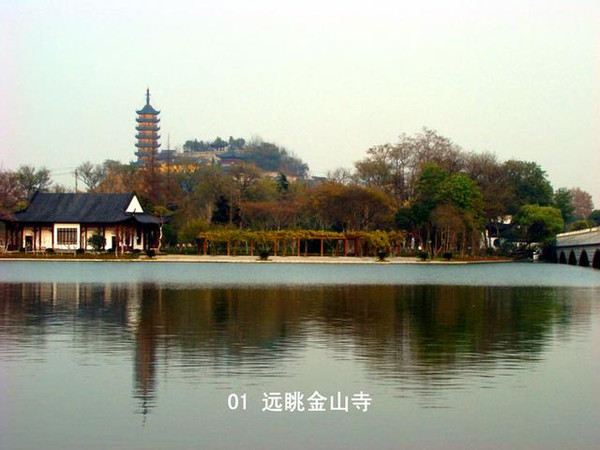
Looking out at Jinshan Temple from afar (Photo: Feng Ganyong)
Zhenjiang, known in ancient times as Jingkou, sits at the throat of the lower Yangtze. Downstream from Zhenjiang, the river suddenly widens, and the three mountains of Jingkou—Jinshan, Jiaoshan, and Beigushan—paint a picture-perfect scene that travelers have long adored. I remember my first trip here was on November 21, 1992. Our team drove to Shanghai for a TV festival and stopped by on the way back. Time flies—seventeen years passed before I returned for a second visit. On December 4, 2009, when I set foot in Zhenjiang again, the brief stop from all those years ago still left a warm impression. What stood out most were the "Three Mountains": Jinshan, Jiaoshan, and Beigushan.
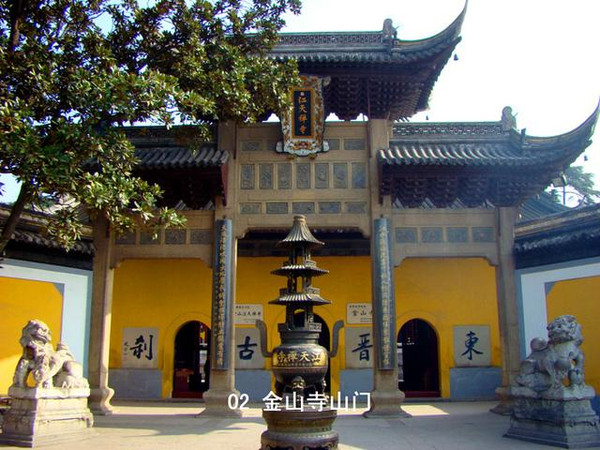
Gate of Jinshan Temple (Photo: Feng Ganyong)
The reason the Three Mountains leave such a lasting impression comes down to the deep cultural heritage they carry. Especially the timeless legends, stories, and historical events that people still love to talk about—Lady White flooding Jinshan Temple, Liang Hongyu beating the war drum at Jinshan to resist the Jin army, Liu Bei's marriage match at Ganlu Temple on Beigushan, and Emperor Qianlong visiting Jiaoshan eight times across six southern tours. As luck would have it, my stay this trip was at Yiquan Hotel, right next to Jinshan Temple. The scenic Taying Lake in front of the hotel connects to Jinshan Lake via a bridge, and the famed Zhongling Spring, hailed as the "Number One Spring Under Heaven," sits right by Taying Lake. The spring falls within the Jinshan scenic area. Walking from Yiquan Hotel toward Jinshan, I passed right by the Zhongling Spring grounds, and so my tour of the Three Mountains kicked off there.
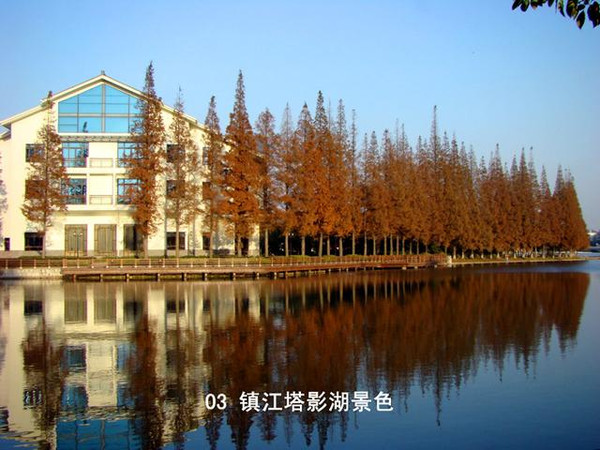
Scenery at Taying Lake, Zhenjiang (Photo: Feng Ganyong)
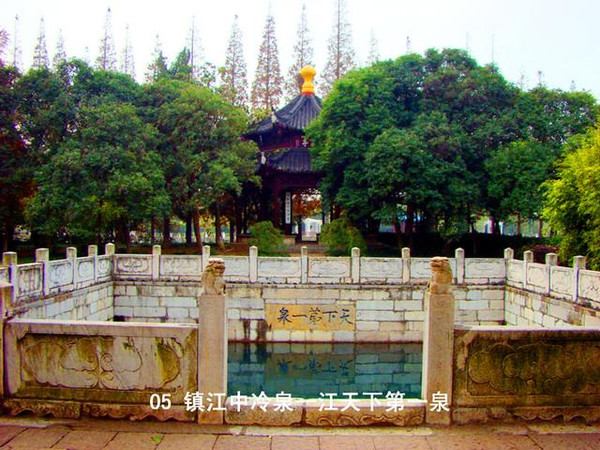
Zhongling Spring, also called Zhongru Spring or Nanling Spring, lies outside Jinshan Temple in Zhenjiang. During the Tang and Song dynasties, Jinshan was still "a lotus blossom in the middle of the river," and the spring sat within the Yangtze itself. According to records, the spring water flowed from the river, which came from the west. Blocked by Shipai Mountain and Hu Mountain, the current twisted and split into three channels—the South, Middle, and North Ling—and the spring emerged beneath the middle bend, earning it the name "Zhongling Spring."
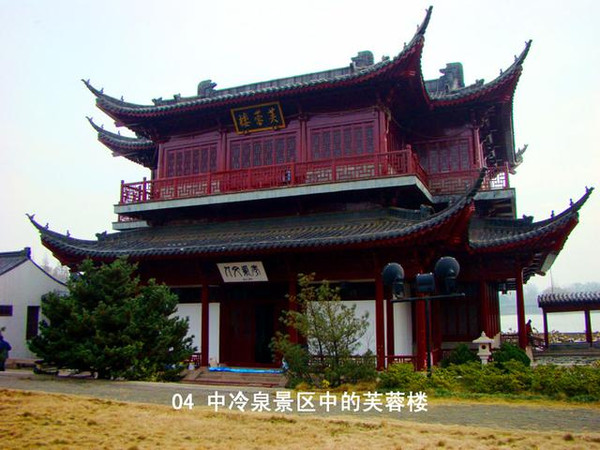
Furong Tower at Zhongling Spring (Photo: Feng Ganyong)
Step into the Zhongling Spring grounds, and a tranquil, leafy courtyard unfolds before you. On the left stands Furong Tower by the lakeside, connected to Three Pools Mirroring the Moon out in the water. Across from the tower on dry land sits the large square pool that is Zhongling Spring itself. The bold characters "Number One Spring Under Heaven" carved into the stone railings on the south side are the work of Wang Renkan. Pavilions and buildings crowd the pool's edge—to the south rises an octagonal pavilion with two tiers of pillars, seven meters across, spacious and airy, named "Jian Pavilion," meaning to take water as a mirror and the spring as a lesson. Inside, stone tables and stools offer visitors a cool, elegant spot to rest.
Number One Spring Under Heaven (Photo: Feng Ganyong)
The waters of Zhongling Spring surge up from the pool's bottom like a white dragon at play. "Green as jade, thick as nectar," the spring runs crisp and mellow, perfect for brewing tea. Tea made with this water is said to be fragrant and clean, with a famed "overflowing cup" quality—pour the spring water into a cup, and it rises two or three fen above the rim without spilling; set a coin on the surface, and it won't sink. That's how Zhongling Spring earned its title as the "Number One Spring Under Heaven." Leave the spring heading southeast along a small path, and you hit Changjiang Road, with Jinshan sitting just north of the intersection. In ancient times, Jinshan was an island standing mid-river—"ten thousand streams pour east, one island stands alone"—forming a strategic triangle with Guazhou and Xijin Ferry, a vital thoroughfare between north and south. Long known for "rising abruptly to command the current, straddling two hundred prefectures to the southeast," Jinshan has gone by many names. The ancients compared the Yangtze to the Sea of Fragrant Waters and likened the mountain to the Seven Jinshan of the Avatamsaka Sutra, hence the name Jinshan.
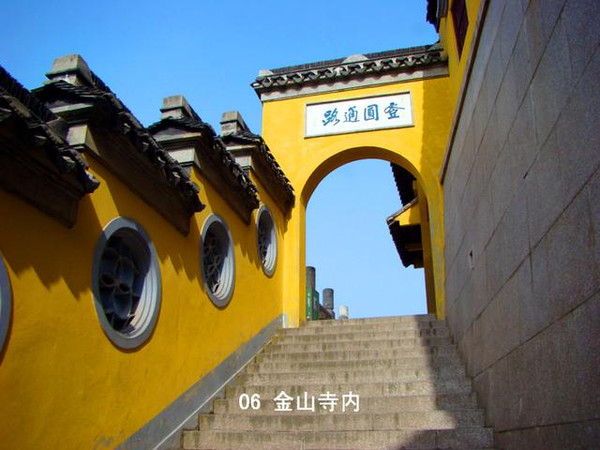
Inside Jinshan Temple (Photo: Feng Ganyong)
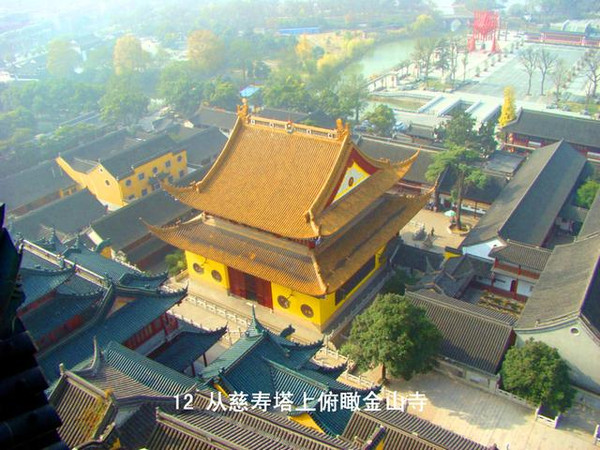
Because Jinshan hugs the riverbank, its architecture is uniquely styled—halls, chambers, pavilions, and towers all built into the mountain, with Cishou Tower jutting up from the summit. Viewed from the river, you see the temple but not the mountain, earning it the reputation: "Jinshan Temple wraps the mountain—see the temple, see the tower, but not the mountain," a hallmark known far and wide.
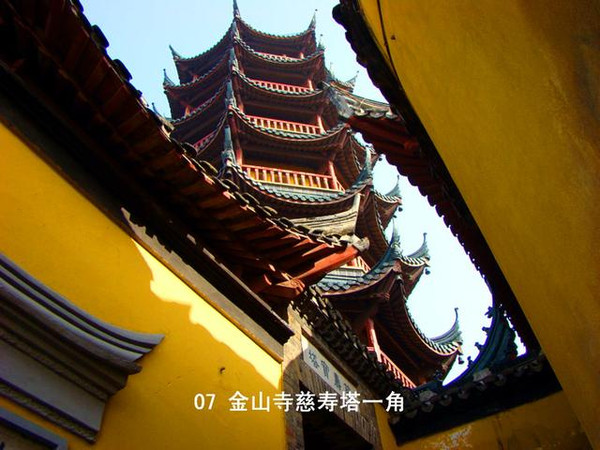
Corner of Cishou Tower (Photo: Feng Ganyong)
Enter the Jinshan Park gate, stroll up the main path, and you'll soon reach the temple's front gate. Look up at the plaque reading "Jiangtian Zen Temple"—bestowed by Qing Emperor Kangxi in the autumn of 1687, when he climbed Jinshan and, seeing it touch the heavens above and the torrent below, with river and sky as one, renamed the temple accordingly, a name it still bears. Jinshan Temple has been a famed Zen sanctuary since ancient times, founded in the Eastern Jin dynasty over 1,500 years ago, originally called Zexin Temple and later renamed Jinshan Temple during the Southern Dynasties and early Tang. Its scale was immense—at its peak, it housed over 3,000 monks and countless clergy. During the Qing dynasty, it ranked among China's four great temples alongside Putuo, Wenshu, and Daming.
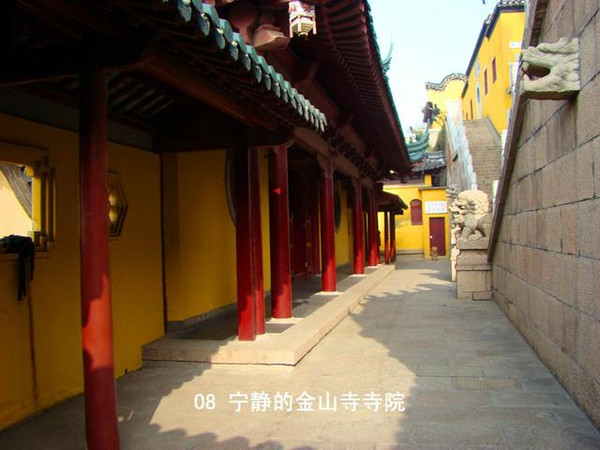
A quiet corner of the temple (Photo: Feng Ganyong)
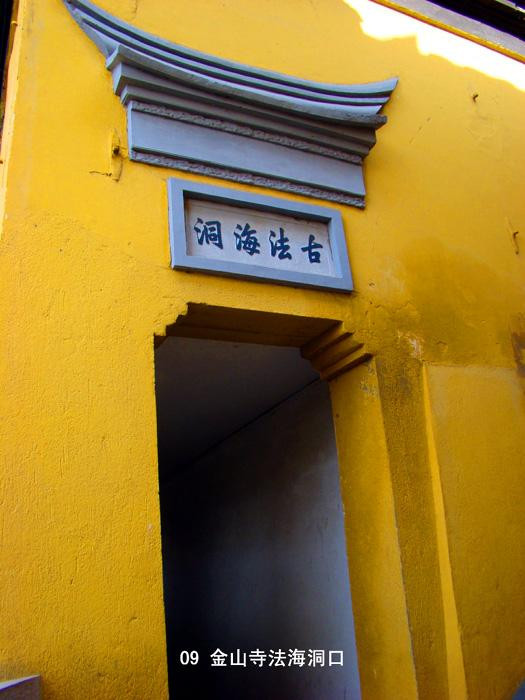
Owing to shifting imperial beliefs, Jinshan Temple twice converted to a Daoist shrine. Once in the Tang dynasty, it became Longyou Abbey for nearly two hundred years. Again in the fourth year of the Zhenghe era under Emperor Huizong of Song, who followed Daoism, it was turned into Shenxiao Yuqing Wanshou Palace, the premier Daoist temple of its kind, before reverting to Longyou Temple. Within the Jinshan scenic area, there are over thirty sights and relics—the famed Jinshan Temple, Fahai Cave, White Dragon Cave, Number One Spring Under Heaven, Furong Tower, Jade Belt Bridge—each with its own moving myth or legend, from the flooding of Jinshan Temple to Liang Hongyu's drumbeat against the Jin army and Yue Fei's prophetic dream. Most famous of all is the tale of the Legend of the White Snake that unfolded here.
Fahai Cave entrance at Jinshan Temple (Photo: Feng Ganyong)
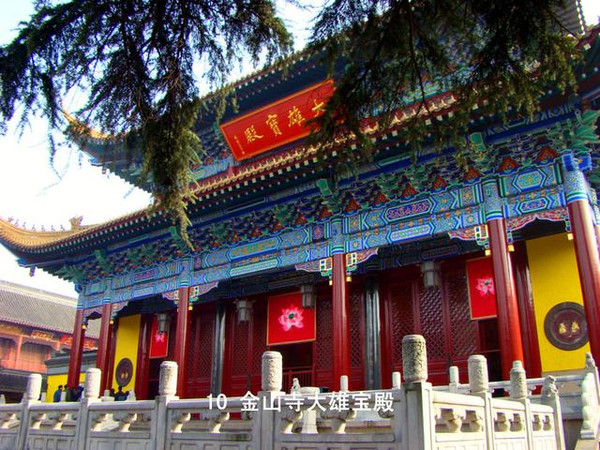
Pass through the temple gate, and the imposing Main Shrine Hall greets you. Sitting at the mountain's foot, it's a double-eaved hip-and-gable structure. Inside hang two enormous convex mirrors that capture the full panorama of Jinshan. The hall burned down in 1948; the 1990 rebuild preserved the original style while using reinforced concrete for added strength and grandeur. Within stand statues of Sakyamuni, Amitabha, and the Medicine Buddha, flanked by eighteen arhats. Behind the main Buddha rises a vast island tableau, with Buddhas, bodhisattvas, and dharma protectors appearing among the clouds, eighteen venerable figures on the sea, and Guanyin of the island riding the waves, attended by Sudhana and the Dragon Girl. Above the hall's center hangs a gilt plaque reading "Main Shrine Hall," penned by Zhao Puchu.
Main Shrine Hall of Jinshan Temple (Photo: Feng Ganyong)
The caves tucked into the mountain each harbor a wondrous tale. Beyond Fahai Cave, there are White Dragon Cave, Chaoyang Cave, and Immortal's Cave, together known as Jinshan's "Four Great Grottoes." Immortal's Cave is said to be where Lü Dongbin gazed out over the river, while White Dragon Cave ties into the Legend of the White Snake.
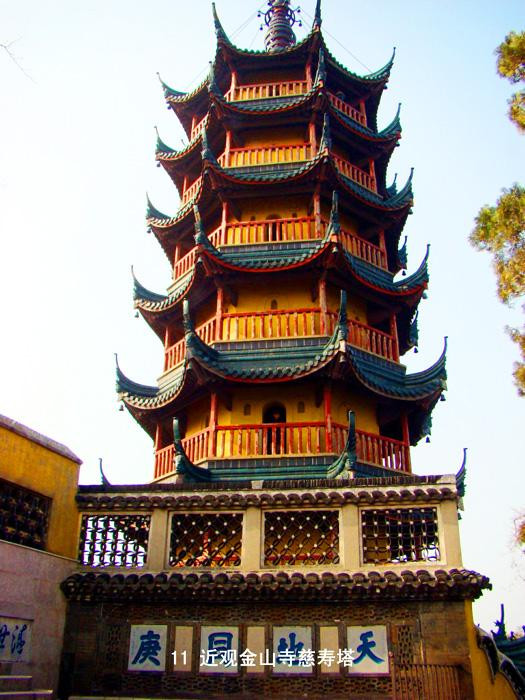
A closer look at Cishou Tower (Photo: Feng Ganyong)
Stone steps flanking the Main Shrine Hall lead up to Cishou Tower. Rising about 30 meters, brick-and-wood, octagonal with seven stories, it crowns the layered halls and terraces, seeming to lift Jinshan even higher. The earliest Cishou Tower was built during the Southern Dynasties' Qi-Liang era