Xishuangbanna: China's Warm Capital and Winter Retreat in 3 Days
When most of northern China is buried under cold waves and snow, Xishuangbanna, tucked away in the far southwest corner of the country, stays warm and breezy, with flowers blooming and trees lush and green. It's China's go-to winter getaway, known as the "Warm Capital." This trip was a self-driving tour. Over three days, I hit all the highlights: Zongfo Temple, Manting Park, the Grand Golden Pagoda, the Starlight Night Market at Jinghong, Wild Elephant Valley, and the Xishuangbanna Tropical Botanical Garden under the Chinese Academy of Sciences. I also went deep into Dai territory to visit the incredibly pristine Manzhang Village. Honestly, the itinerary couldn't have been better.
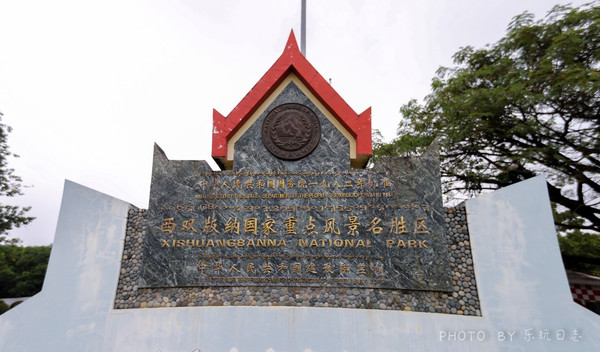
Picking up the car at the airport, I spotted the sign for Xishuangbanna National Key Scenic Area and felt a surge of excitement. The airport is only 8 kilometers from downtown—a ten-minute drive. Zongfo Temple
One of the must-see spots in Xishuangbanna is Zongfo Temple, and since my guesthouse was right next to it, getting there was a breeze.
Zongfo Temple is the highest-ranking Buddhist temple in Xishuangbanna. According to the introduction at the entrance, its Dai name is "Wabaji"—"Wa" means temple, "Ba" means forest, and "Ji" is short for Jetavana, the garden where the Buddha spent 25 rainy retreats. So "Wabaji" essentially means a beautiful, tranquil forest monastery just like Jetavana.
The temple was first built in 615 AD, giving it over 1,400 years of history. It was founded by two senior monks who came from Myanmar. It's said to be the first major Buddhist temple built in Xishuangbanna after Theravada Buddhism arrived.
In ancient times, the entire Xishuangbanna region practiced Buddhism, and every village reportedly had its own temple. Zongfo Temple was the highest authority, overseeing all of Xishuangbanna. Any region-wide Buddhist event would be sworn in and held here. Even today, this former royal temple of the Dai kings still governs over 590 temples of various sizes across the entire Xishuangbanna Dai Autonomous Prefecture.
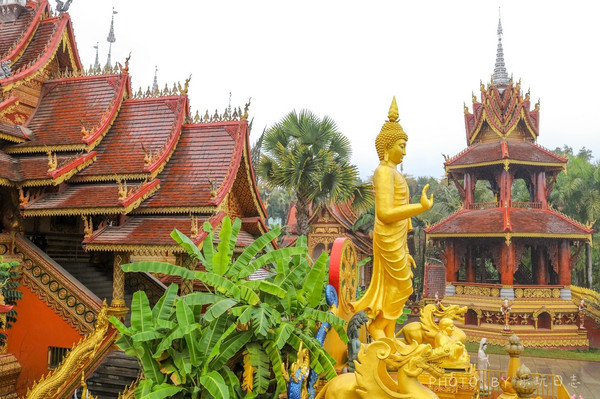
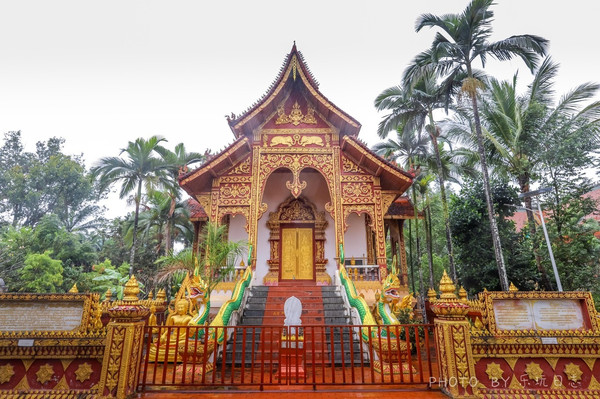
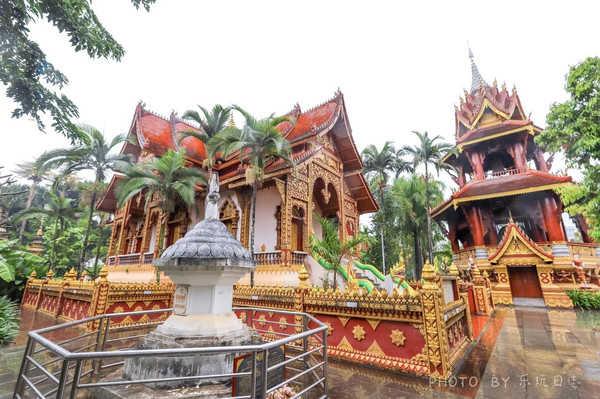
After its construction, the temple suffered damage from wars and other causes over the centuries. The current buildings are reconstructions, but the architectural style is quite different from other parts of China. The temples here lean much more toward Thai style.
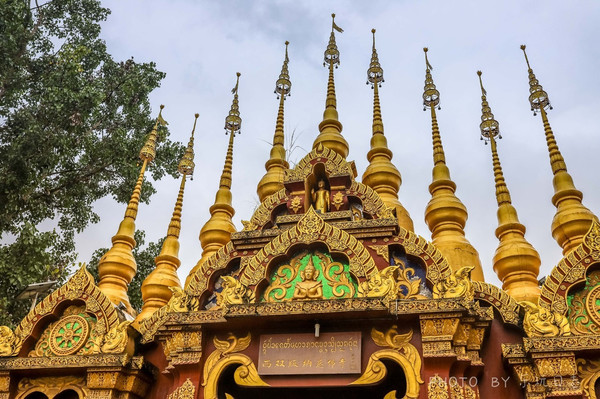
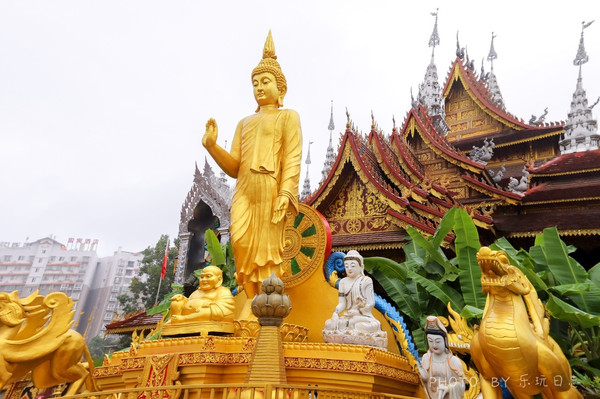
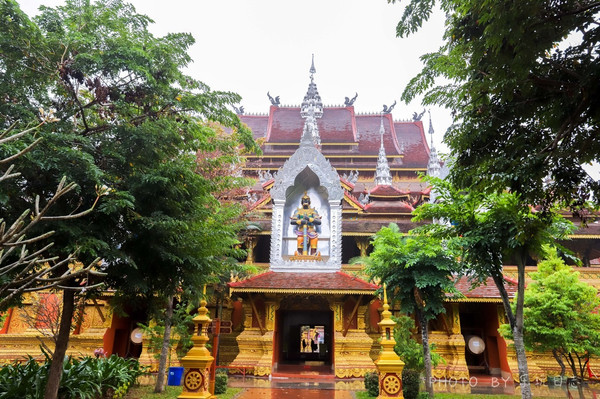
The pagodas above the main gate, for instance—there are exactly nine of them, and the tiers above are all odd numbers too. Gilded and dazzling, they're a sight to behold.
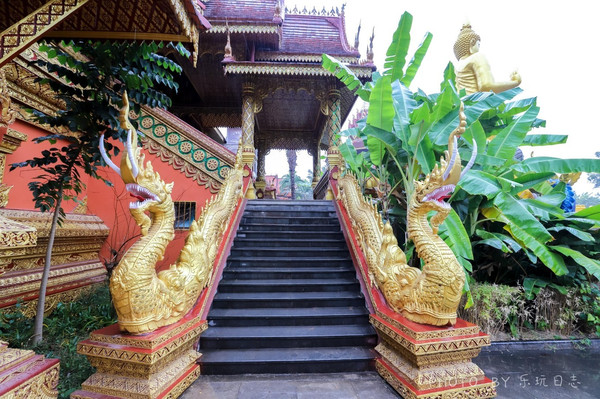
The sculptures inside the temple are exquisite. Even the railings are shaped like golden dragons, vivid and lifelike.
Looking at these gilded temples and Thai-style pagodas, you might feel like you've been transported to Thailand. But really, this is traditional Dai architecture.
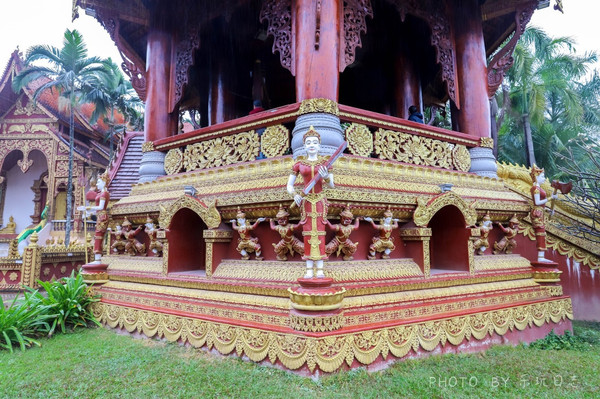
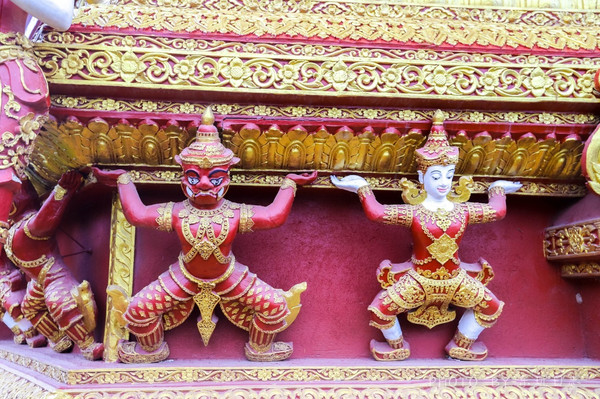
On either side of the main hall stand a bell tower and a drum tower, both wooden structures adorned with carved wooden figures.
There are figures wearing masks with sharp fangs.
The Buddhist academy shares the same compound as Zongfo Temple and isn't open to tourists.
A side view of the Buddhist academy.
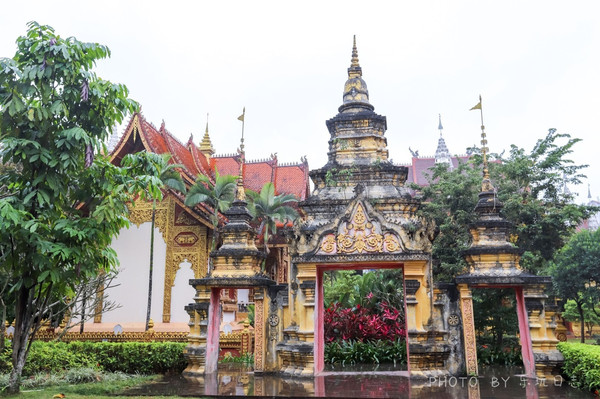
Zongfo Temple and the Buddhist Academy cover over 3,000 square meters, enclosed by walls into a rectangular courtyard. On the south side, the old temple gate still stands, connecting to Manting Park.
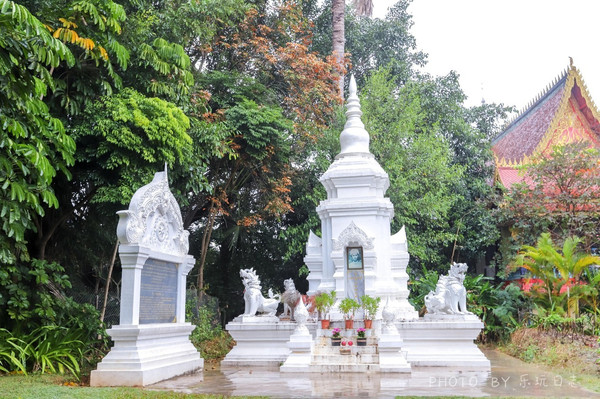
The white pagoda—our guide said it's the tomb of the last Dai king. Quick tip: Zongfo Temple is on Baji Road in Jinghong City, Xishuangbanna. Admission is free. The road in front is strictly controlled—no parking. Manting Park
Manting Park sits right behind Zongfo Temple. As the oldest park in Xishuangbanna, it has over a thousand years of history. It used to be the royal garden of the Dai kings, a place where lords and chieftains would stroll and enjoy the flowers.
Legend has it that a beautiful Dai princess was so captivated by the garden's scenery that her soul stayed behind. When she returned to the palace, she was dazed and out of sorts.
When the Dai king consulted his royal advisor, he learned that the princess's soul had remained in the garden. He immediately summoned the finest gardeners in the land and had the rarest tree species from Xishuangbanna's forests collected and planted there. He named the royal garden "Manting," which in Dai means "Garden of the Soul."
After buying a ticket and stepping inside, I was surrounded by towering greenery and a dizzying variety of plants and flowers—it felt like tropical Southeast Asia. The most common tree here is the ever-green ironwood, named for its hardness that resists even axes. The garden blends natural landscapes with cultivated exotic flowers and plants, alongside architecture rich in Dai cultural character.
The Manfeilong White Pagoda is entirely white, composed of a central mother pagoda surrounded by eight smaller ones. They sit on a large circular base, with the mother pagoda in the center and the smaller ones arranged around it like stars around the moon. Each small pagoda has a shrine niche, topped with a clay phoenix with outstretched wings.
Manting Royal Garden features three main themes: Dai royal culture, Buddhist culture, and ethnic customs.
The Dai architecture blends beautifully with the flowers and greenery throughout the park.
Snap a photo anywhere and it'll blow up your social media feed.
This central pagoda is the architectural heart of the city. Its design is classic Dai royal style, covered entirely in "golden water" painted murals. The layered eaves stack up like mountains, and the golden roof gleams brilliantly.
The windows are carved with golden petals too—really something to see.
At the base inside the pagoda are four deities—the guardian spirits of the Dai people.
The ceiling murals depict scenes of Dai people celebrating and going about daily life, praying for bountiful harvests.
Manting Park is also full of exotic flowers and unusual trees. Take this bougainvillea—a single tree with three different colors, each one trying to outshine the others. It was quite an eye-opener.
White flowers—first time I'd ever seen them. In Guangzhou, most are pink.
And orange-red ones too.
Can you guess what this building is for? A coffee shop.
Even the railings are carved with dragons—very unique. You definitely won't find this in other Chinese cities.
This tall pagoda has a bit of that Sukhothai Old City vibe from Thailand.
The plants here grow incredibly well, and there's such a variety. Just wandering through feels wonderful.
It had just rained when I arrived. After the rain cleared, the air was especially fresh.
You can also go boating in the garden or watch performances, though you'll need to check the announcements—during the pandemic, many shows were suspended.
Quick tips: Opening hours 08:00–17:00. Tickets 40 RMB. Address: 35 Manting Road, Jinghong City, Xishuangbanna Dai Autonomous Prefecture, Yunnan Province. What to Eat in Xishuangbanna
Xishuangbanna is a food lover's paradise. The Dai-style cuisine here will have you raving. It's the distinctive flavor of this ethnic minority. BBQ is the star—the late-night food culture at the Starlight Night Market is something special. This is the only city in China where everyone barbecues, where the whole city barbecues. The Starlight Night Market is next to the Grand Golden Pagoda and stays open until 2 AM. If you're visiting Xishuangbanna, a night market food crawl is mandatory.
The Starlight Night Market only starts after dark. Since it was still dinner time, I grabbed a proper meal first before heading to the night market for late-night snacks.
The Grand Golden Pagoda Temple is quiet during the day. I snapped a few photos, then went to eat.
The main entrance is flanked by elephant statues.
Dinner wasn't expensive. First dish: curry squid—generous portion, eggs mixed with curry and squid, topped with chopped scallions.
Curry shrimp. Xishuangbanna is also called "Little Thailand," and the food here is pretty similar to Thai cuisine. They love curry and sour-spicy flavors.
Pork over rice, with cucumber and a sour-spicy sauce.
Tom yum goong soup, loaded with seafood—shrimp, crab, squid—sour and spicy, appetizing and delicious.
The must-eat dish in Xishuangbanna is Dai-style roast chicken. Absolutely incredible. "Killed fresh, roasted fresh" is the hallmark here. It's served on a banana leaf tray, and you dip it in a secret spicy powder for extra crispiness and flavor.
The Dai snacks inside the Starlight Night Market are worth trying too. I'd recommend the oil-blasted heart tubes and lemongrass-grilled fish—both excellent.
Dai BBQ is wonderfully rustic, all held together with bamboo skewers, and nothing's expensive.
Plenty of grilled fish options, all cheap—25 RMB for a tilapia.
And grilled pork belly, 50 RMB per portion—a bit pricey, but it's free-range farm pig, quality ingredients, and you can taste the difference. Starlight Night Market
The night market is a major attraction in Xishuangbanna and one