Jiaodong Children's Ocean Play Festival: A Two-Day Qingdao Travel Guide
This was my second time in Qingdao, but like before, I was short on time—only two days to work with. Last trip, I stuck mostly to the old city, wandering through colonial-era buildings and watching people mess around by the shore. This time, I made up for what I missed by heading to Laoshan in the far north and the Huangdao district down south. Both spots are pretty far from the main city, and public transit just eats up too much time. If you want to follow my route, you really need to rent a car and drive yourself.
About the itinerary
Day 1: Yangkou Scenic Area—Momer—Taiqing Palace
Day 2: Qingdao Binhai University World Animal Museum—Golden Beach—Starlight Island—Mangrove Resort World
Yangkou Scenic Area
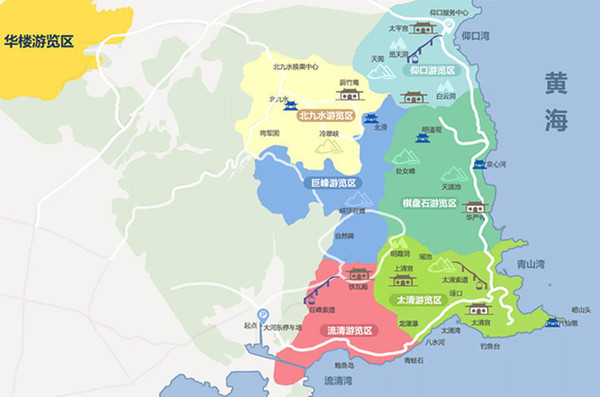
Yangkou—Momer—Taiqing Palace all sit within the Laoshan Scenic Area. Laoshan is actually a massive park (see map below). Yangkou is at the far northwest, with Momer a few kilometers south, and Taiqing Palace at the southern tip. The road between them used to connect, but now you have to enter through separate visitor centers for Yangkou and Taiqing Palace.
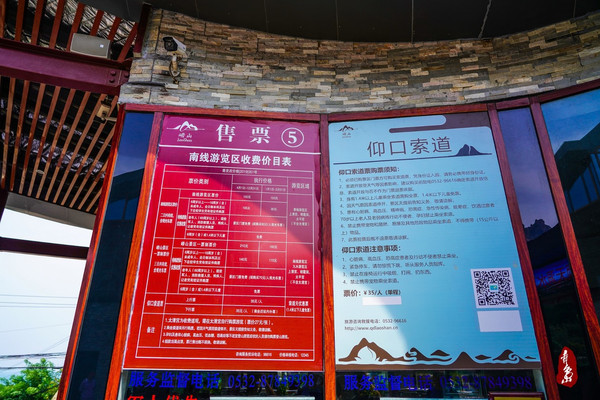
Worth noting: all of Laoshan's scenic spots are currently free to enter—you only pay 60 yuan for the shuttle bus ticket. For Yangkou, you don't even need the shuttle; just drive to the Yangkou parking lot and the entrance is right across the street. Plus, parking at all Laoshan lots is free, which is something other scenic areas across the country should really take notes on.
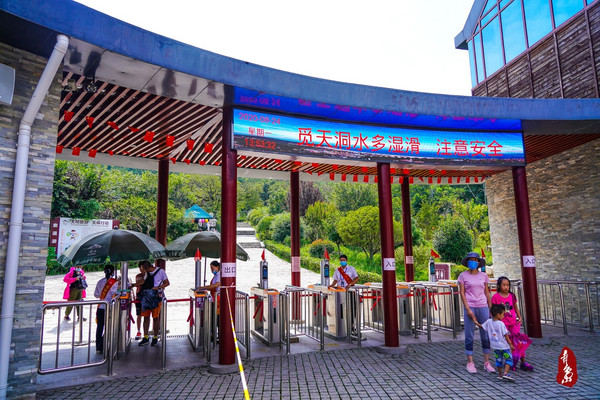
Even though admission is free, you still need to register your ID card in advance on Laoshan's official website. Once you arrive, just scan your ID at the gate and you're in.
Inside the entrance, the Yangkou cable car station is on your left. A one-way ticket costs 35 yuan and runs about 20 minutes. Honestly, it's a decent deal—if you hike up in this heat, you'll be exhausted and drenched in sweat. And even after the cable car drops you off, there's still a stretch of climbing to reach the summit. My advice: take the cable car up and walk down, so you don't miss any of the scenery along the way.
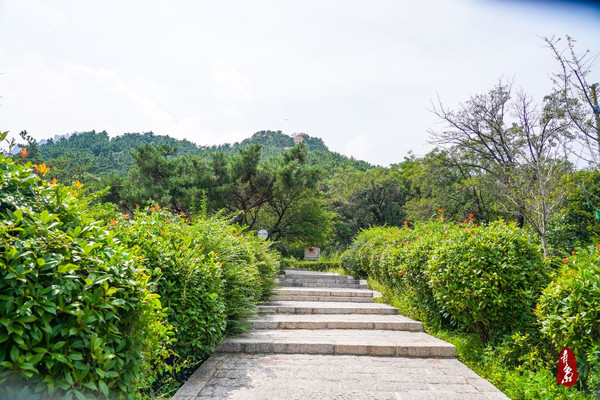
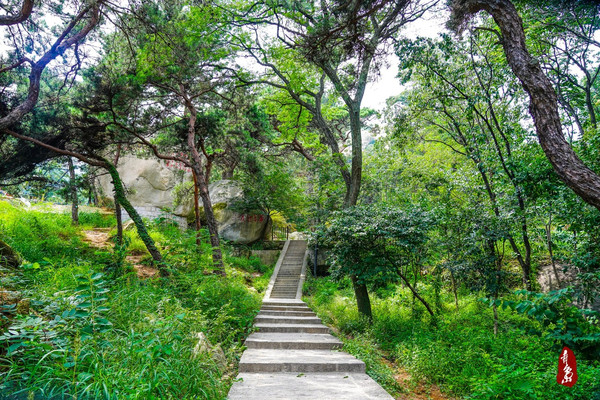
That's the path up top—not too steep, pretty easy to walk, just brutally hot.
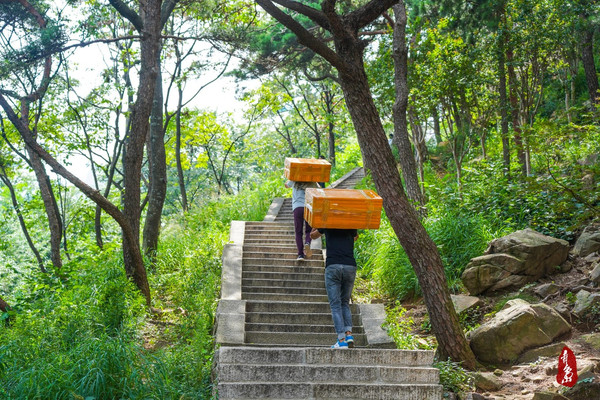
Midway on the cable car, I spotted people hauling supplies up the mountain on their backs. No wonder bottled water costs so much up there—everything's carried up by hand.
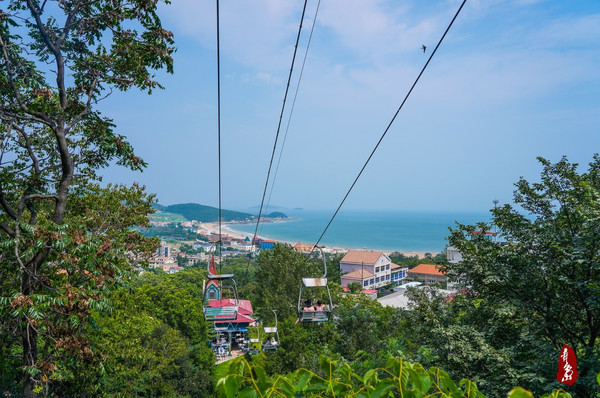
On one side, hikers pushing upward; on the other, tourists lounging in the cable car.
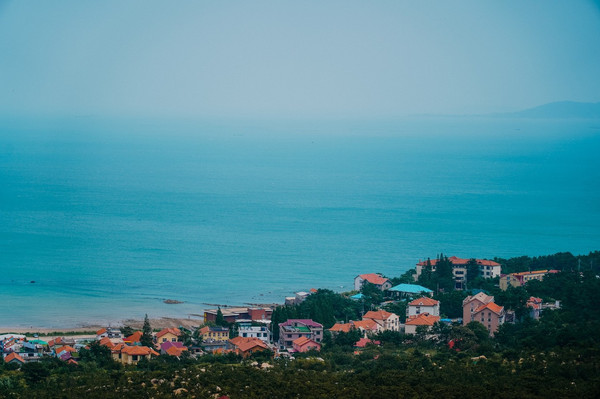
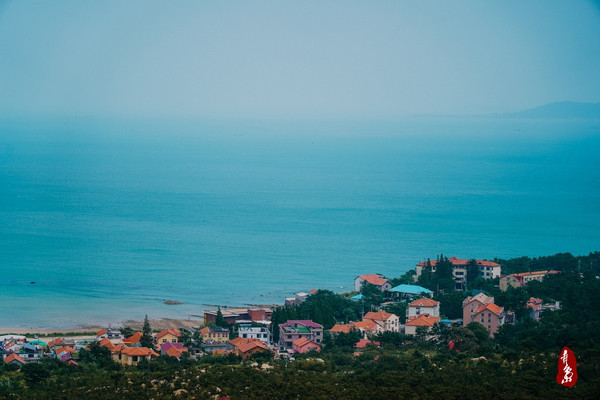
About ten minutes in, the coastline comes into clear view. Growing up in Sichuan, I still get awestruck every time I see the ocean—it's just so vast and powerful.
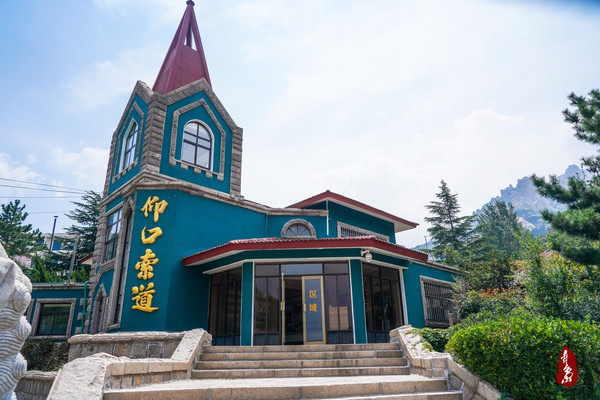
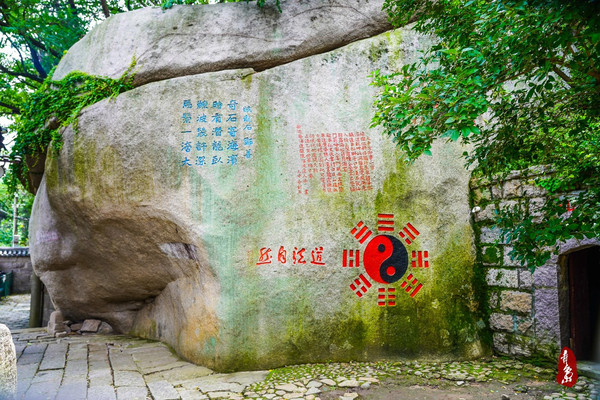
On a big boulder by the stone steps, four bold characters read "Huagai Welcomes Guests"—referring to Huagai Zhenren Liu Ruozhuo, a famous Taoist priest in Laoshan's history.
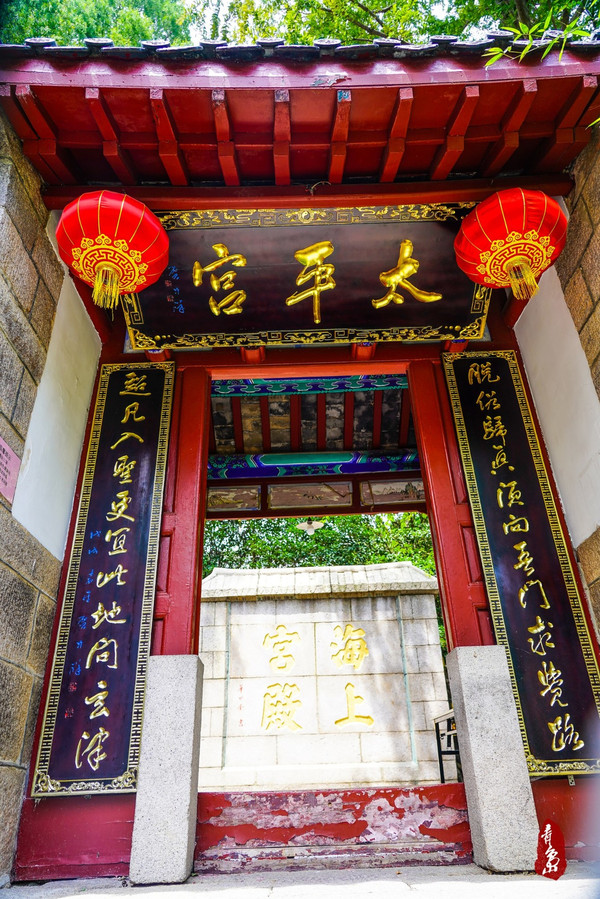
Keep climbing and you'll reach Huagai Zhenren's temple, Taiping Palace. Among Laoshan's surviving temples, it's the oldest Taoist site with documented history.
According to inscriptions from renovations in 1566 (Ming dynasty) and 1653 (Qing dynasty), Taiping Palace was built by Emperor Taizu of Song (Zhao Kuangyin, r. 960–976) as a place of practice for Liu Ruozhuo. It was originally named Taiping Xingguo Temple after the Taiping Xingguo era, then later renamed Taiping Palace.
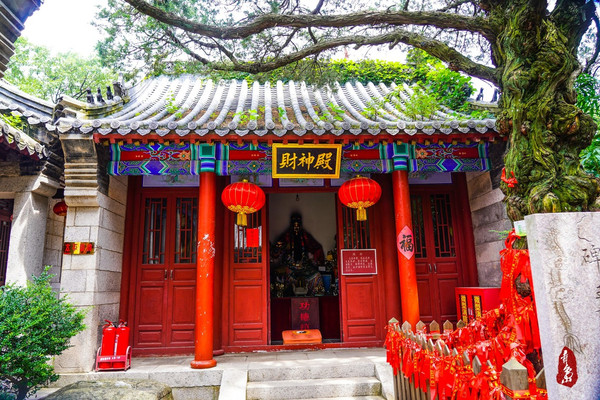
Inside, ancient trees burst with fresh leaves, thriving under the summer sun. We wandered into the inner courtyard and spotted a juniper with a strange, bumpy trunk—fittingly nicknamed "the lumpy juniper." In this incense-filled temple, its gnarled knots oddly fit right in, adding a distinct kind of charm. Beneath it sits the Hall of Wealth.
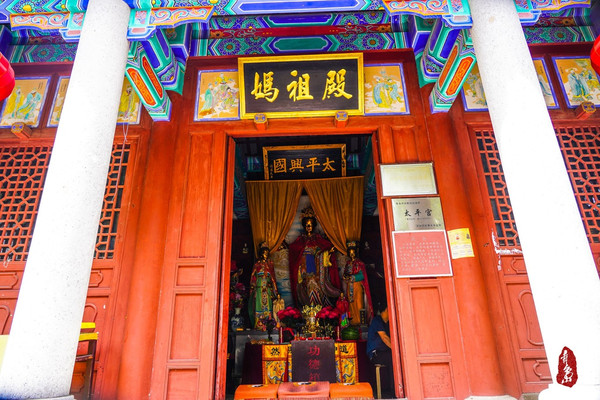
The main hall is dedicated to Mazu.
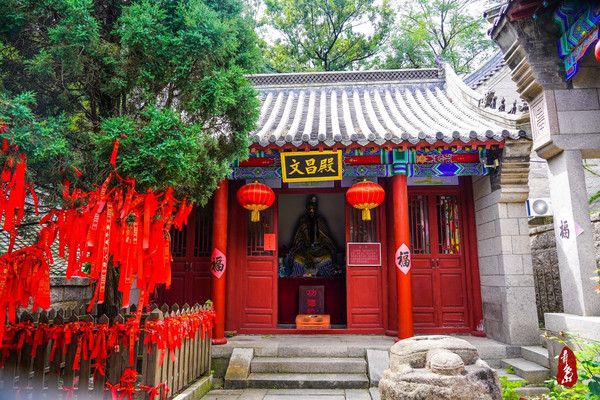
The side hall on the left is the Wenchang Hall.
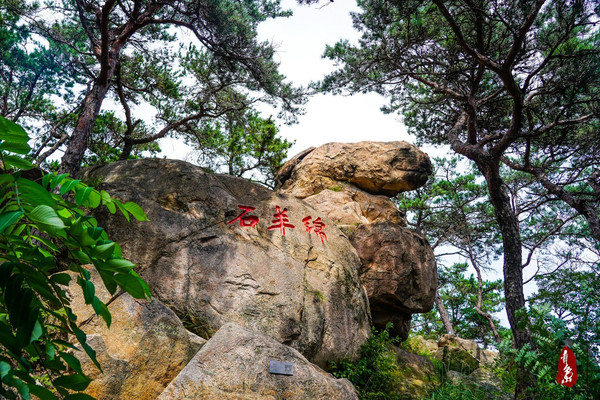
Past the small path to the right of Taiping Palace, the climb continues and the scenery shifts. Rocks of all sizes begin to take on animal-like shapes.
There's also a viewing platform up here with a sweeping view of the coastline. From this spot, the view is actually the best—even better than from higher up.
Ocean on one side, mountains on the other. That's what draws me to Qingdao. People say if you haven't been to Laoshan, you haven't really been to Qingdao. So I had to make the trip.
Lion Peak
Honestly, skipping the cable car has its perks. You measure Laoshan step by step from the base, discovering little surprises along the way. The feeling is totally different from zipping to the top, soaking in the summit views, then ambling down past the sights. After taking in the sea and mountains, reaching this giant "Longevity" character carved into the rock hit me differently.
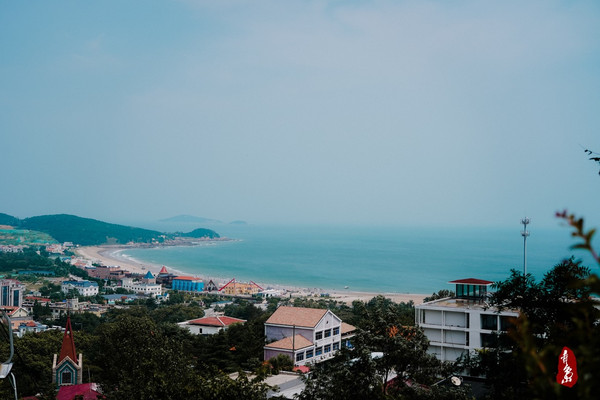
Then I looked back at the path I'd walked and the beautiful beach below.
The beach across from the Yangkou entrance is public. Despite the heat, the parking lot was packed—most people were heading straight for the sand. If I'd had more time, I'd have loved to just lie back and rest on the beach.
Momer
Leaving Yangkou, I kept driving along the coastal road and reached the Momer guesthouse in about ten minutes.
This place, called Momer, has become a landmark in the area. A four-story villa with a green roof and red brick exterior, it carries strong Qingdao character. Built on the original structure, Momer makes the most of its cliffside perch and ocean views. When Laoshan's main spots get overcrowded, you can stay here in this quiet corner between sea and mountain, claiming the best of Laoshan for yourself.
I loved the cliffside setting—the ocean and a small village spread out before you. Sitting on the edge with a coffee, letting the sea breeze roll in, that's pure bliss.
There's also an infinity pool on the cliff—a big hit on local social media. On a clear day, it must be stunning.
Every room facing the sea has floor-to-ceiling windows. On good days, sunlight pours in with a shimmering glow, and the wide stretch of white sand practically begs you to run down and explore. Evenings paint the sky and sea in sunset hues; nights bring a sky full of stars, and if you're lucky with the season, you might even catch a shooting star.
Taiqing Palace
The other must-visit spot in Laoshan is Taiqing Palace. One heads-up: after finishing Yangkou, you need to drive to the Dahedong Visitor Center to catch the shuttle to Taiqing Palace.
The shuttle ticket is a pass that covers all of Laoshan, but you have to board at the right visitor center for each stop. The last shuttle leaves at 5:30 PM, running every 20 minutes—don't miss the final ride back.
The road to Taiqing Palace hugs the cliffs along the coast—gorgeous views the whole way. Grab a seat on the right side. Too bad there are no pull-offs to stop and take photos.
The last stop is Laoshan's famous Taiqing Palace, the oldest and largest Taoist complex in Qingdao, with over 2,100 years of history.
Laoshan is dotted with temples—locals say it has "nine palaces, eight observatories, and seventy-two hermitages"—and Taiqing Palace is the most renowned. Records say that during the Han dynasty, a man named Zhang Lianfu from Ruizhou, Jiangxi, gave up his official post to cultivate the Tao in Laoshan. He built a thatched hut to honor the Three Officials, calling it the Temple of the Three Officials. In 904 AD, Taoist Li Zhexuan expanded it with halls for the Three Sovereigns, naming it the Temple of the Three Sovereigns, later renamed Taiqing Palace. During the Jin dynasty (around 1190–1196), the Quanzhen Taoists Qiu Chuji and Liu Changsheng taught here. Liu founded the Suishan branch of Quanzhen Taoism, drawing many followers, and Taiqing Palace became its ancestral home.
Among the many Taoist temples in Laoshan, Taiqing Palace is the earliest recorded ancestor of the faith. It's been renovated in nearly every dynasty, yet still retains the classic Song-dynasty architectural style—something rarely seen in religious buildings across China.
When you're worn out from exploring, there's even a Western-style KFC across from Taiqing Palace for a break.
Qingdao Binhai University World Animal Ecology Museum
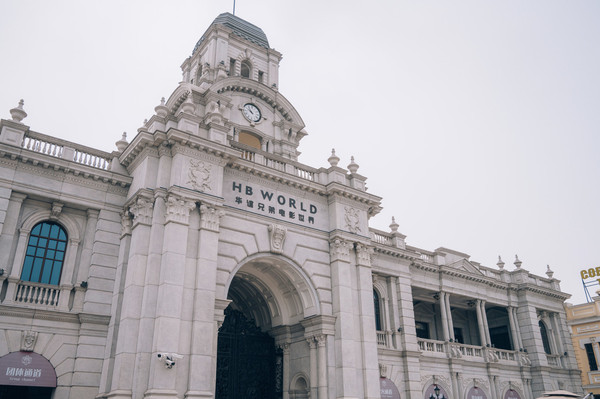
I only found out after arriving that there's a 4A-rated scenic spot—and a museum at that—tucked inside Qingdao Binhai University. Time needed: 1–2 hours. Admission: 80 yuan (adult). Getting there: drive (you must reserve in advance via the museum's official WeChat account; if driving, enter your license plate number, and you can enter campus directly the next day).
The museum opened in March 2005, covering over 14,000 square meters with more than 10,000 items in its collection. It's a comprehensive venue blending natural ecology, animals, geology, and oil paintings.
The museum spans two buildings, with exhibits arranged in