2023 Climbing Mount Tai in the Snow
Prologue: The main stops on this Bohai Sea trip were: first, Dalian (including Lüshun); second, Yantai (including Penglai); third, Weihai; fourth, Qingdao; fifth, Jinan; sixth, Tai'an. The trip ran from late October into early November, spanning 22 days in total.
Day One: Mount Tai — Zhongtian Gate, Five-Daifu Pines, Eighteen Bends, South Heaven Gate, Bixia Shrine, Jade Emperor Peak
Mount Tai hardly needs an introduction. Since ancient times, the Five Sacred Mountains have been revered as the lords of all peaks, and Tai stands at their head, earning the title "Number One Mountain Under Heaven." It sits in Tai'an, and in remote antiquity it was called Huoshan or Taishan—"Tai" simply meaning "great," as the characters for "great" and "supreme" were interchangeable in classical texts. During the Spring and Autumn and Warring States periods, sound shifts and synonym evolution blurred the lines between "Tai" and "Tai," "Dai" and "Dai," and "Dai" and "Yue," giving rise to names like Taishan, Daishan, Daizong, and Daiyue. The character "Tai" itself grew from meanings of towering and unimpeded to suggest "vast and steady, steady and secure," which in turn produced sayings like "as steady as Mount Tai," "the nation at peace and the people secure," and "as weighty as Mount Tai, as light as a feather."
The ancients saw Mount Tai as a direct passage to the Celestial Throne, a sacred mountain where commoners worshipped and emperors offered sacrifice. There's an old saying: "When Mount Tai is secure, all under heaven is secure." Records claim that even before the Qin dynasty, rulers like Fuxi, Shennong, the Flame Emperor, the Yellow Emperor, Yao, Shun, Yu, and Tang made pilgrimages here, and legend holds that 72 sovereigns came to perform the feng and shan rituals before the Qin-Han period. After them came Qin Shi Huang, Emperor Wu of Han, Emperor Wen of Sui, Emperor Gaozong of Tang, Empress Wu Zetian, Emperor Zhenzong of Song, the Kangxi and Qianlong emperors of Qing—all climbing to offer sacrifices and inscribe their achievements on stone. From Qin-Han through Ming-Qing, emperors conducted the feng and shan ceremonies on Mount Tai 27 times. Literary figures also flocked here through the ages, leaving thousands of poems and inscriptions—Confucius's "Song of the Mounds," Sima Qian's "Treatise on the Feng and Shan Sacrifices," Li Bai's "Chant of Mount Tai," Du Fu's "Gazing at the Sacred Peak." The mountain's stone carvings and steles form a comprehensive museum of Chinese calligraphy, with seal, clerical, regular, and cursive scripts all represented—a rich cultural heritage.
Mount Tai is majestic and steep, with stone ravines, pine forests that roar in the wind, and seas of clouds like jade plates. Its beauty is both spectacular and refined. The main peak, Jade Emperor Peak, rises about 1,545 meters above sea level. It's a 5A scenic area, China's first World Cultural and Natural Heritage site, and one of the "Famous Calligraphy Mountains" and "Top Ten Cultural Mountains of China."
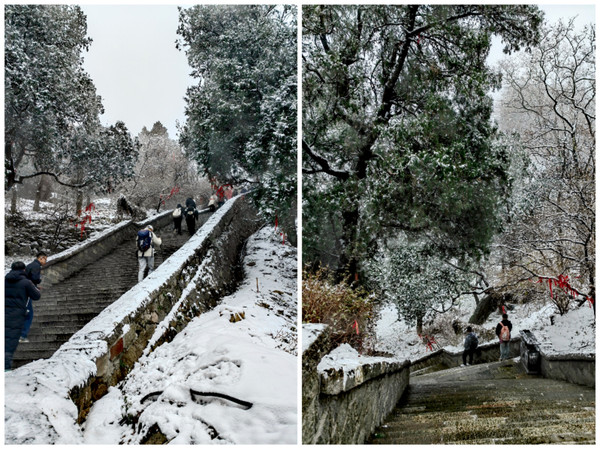
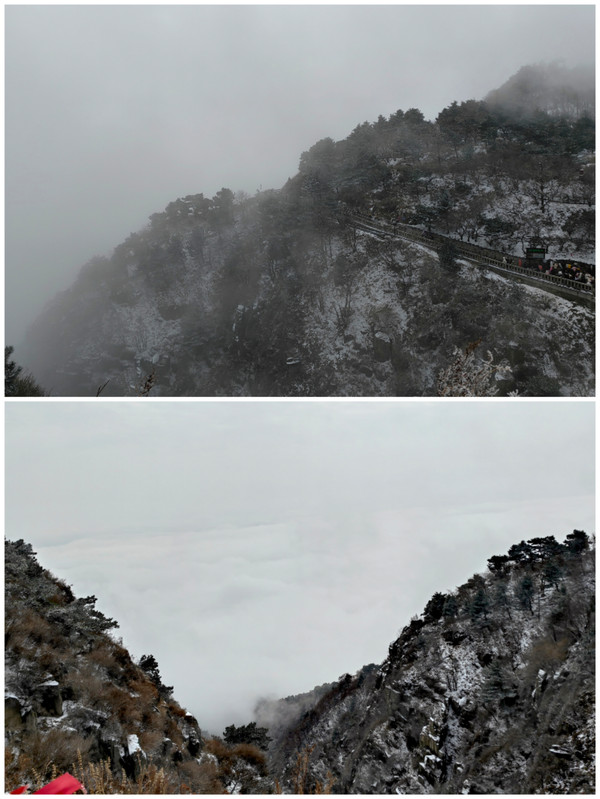
We arrived at the foot of the mountain at dusk, just as the weather forecast was issuing a cold wave warning. I worried we might catch an autumn rain, but the next morning we woke to find an early snow had quietly fallen. Climbing Mount Tai in the snow—that's a flavor all its own.
I chose the less strenuous route, taking a tourist bus from Tianwaicun straight to Zhongtian Gate, a 30-minute ride covering about 15 kilometers. Along the way passed Longtan Reservoir, White Dragon Pool, Black Dragon Pool, Fan Cliff, and Aolai Peak. Driving those switchback roads in the snow, I could only marvel at the steep ridges, dense forests, and the enchanting snowy scenery.
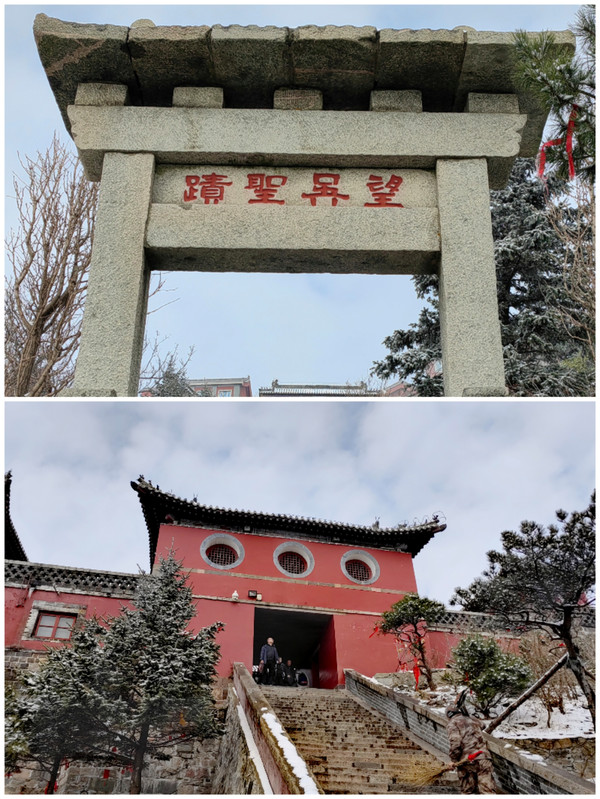
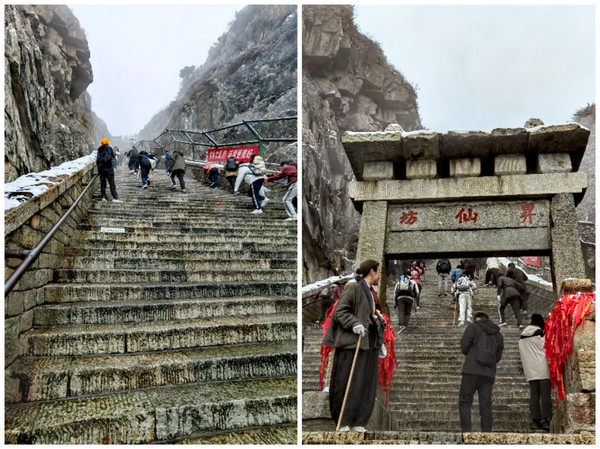
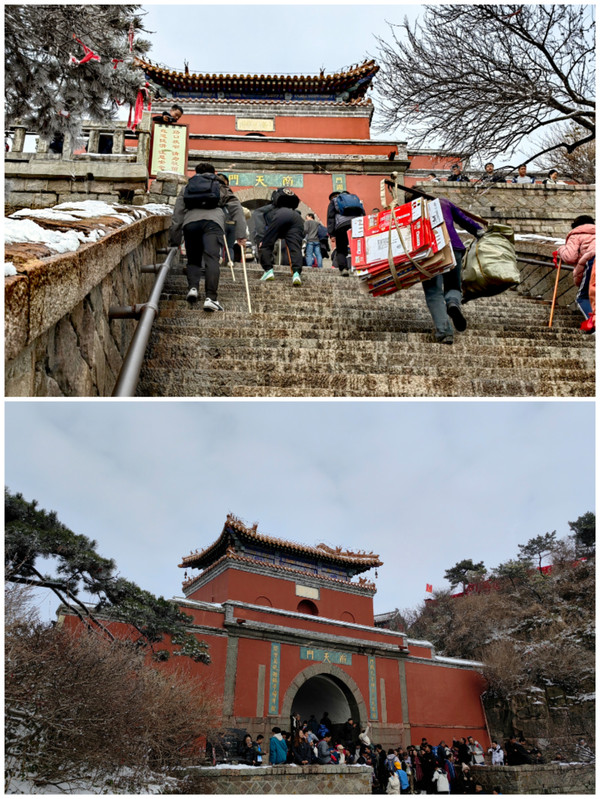
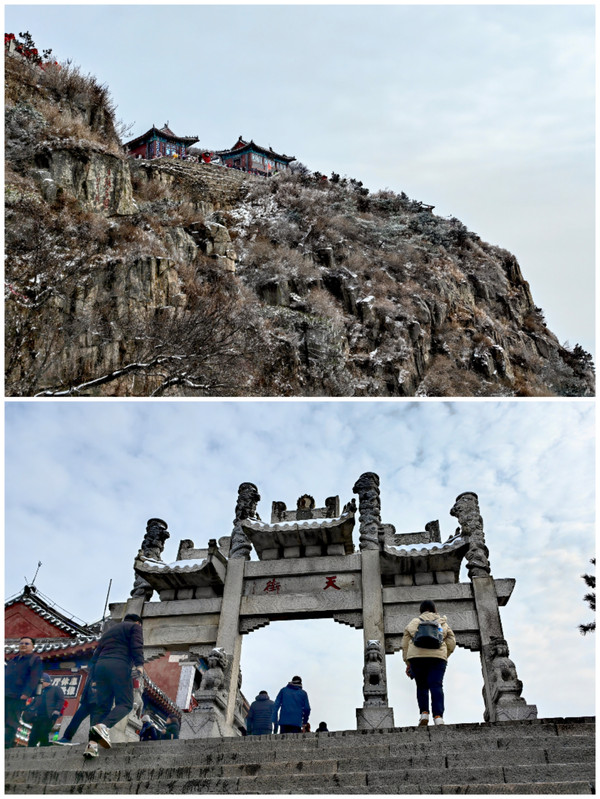
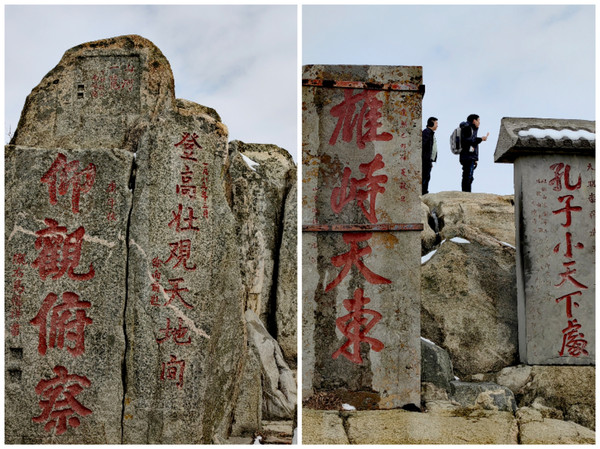
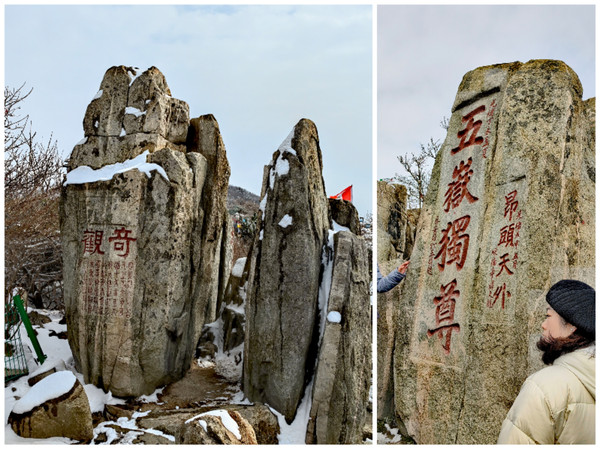
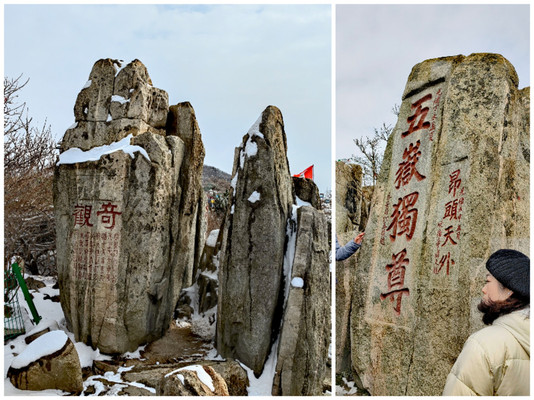
After getting off at Zhongtian Gate, the path up is nothing but stone steps—which is why so many people find Mount Tai a grueling climb. From Zhongtian Gate to Jade Emperor Peak there are 3,967 steps, rising from 800 to 1,524 meters. Key sights along the way: Zhan Cloud Sword (step 272), Cloud Step Bridge (step 535), Five-Daifu Pines (step 689), Greeting Pine, Chaoyang Cave (step 1,074), Dui Song Mountain (step 1,635), Eighteen Bends, Ascending Immortal Archway (step 2,816), South Heaven Gate (step 3,296), Heaven Street, Confucius Temple, Bixia Shrine (step 3,620), Tang Cliff Inscriptions (step 3,716), "Solemn Among the Five Peaks," and Jade Emperor Peak (step 3,967).
Zengfu Temple.
Yingtian Archway.
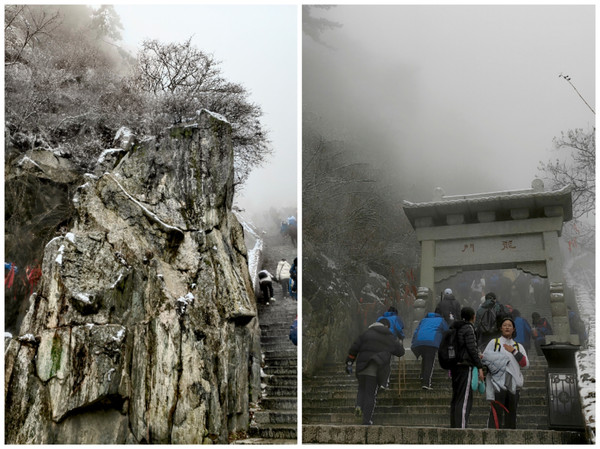
Zhan Cloud Sword. Here at the valley mouth, the cold clouds from the main peak descend and meet warm air, turning to rain—hence the ever-shifting mists. This great rock thrusts skyward like a sword, named for its power to "cut clouds and summon rain."
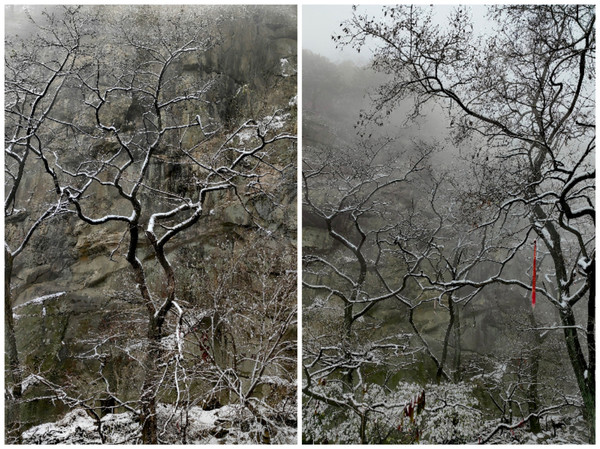
Deep forests, swirling snow and fog—it felt like walking through a dream.
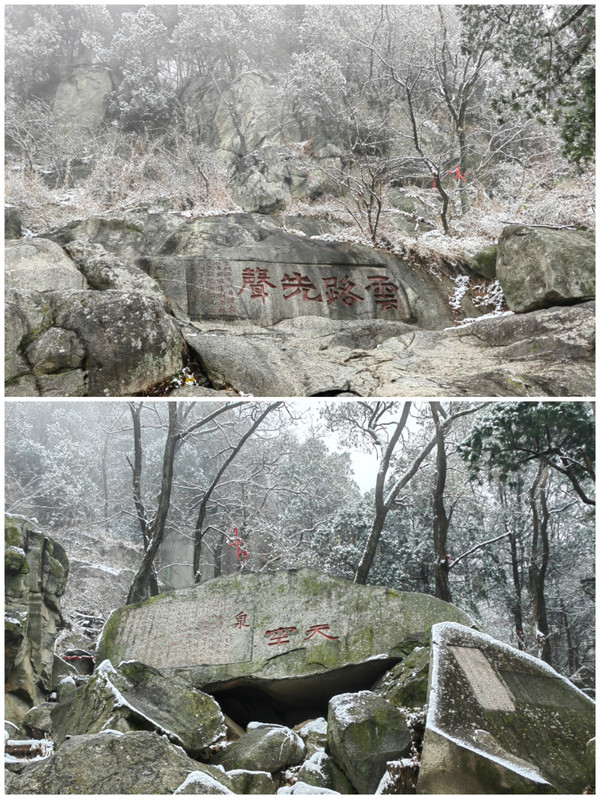
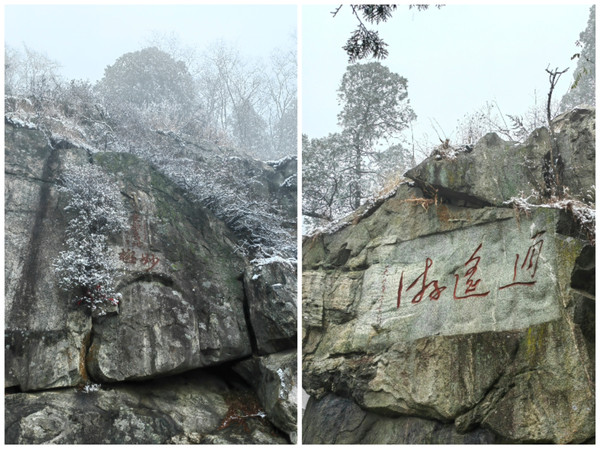
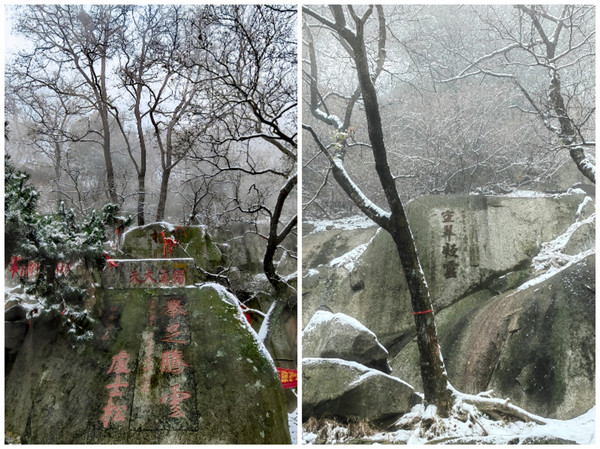
The carvings "Yun Lu Xian Sheng" (First Voice on the Cloud Path) and "Tian Kong" (Sky) and "Quan" (Coin). "In the year of bingchen, the year after I came to Dai, in spring, violent winds were many and cold and warmth came irregularly, and I fell ill. After recovering, moved by the thing called money, I reflected: what is this thing? Have it and you live; lack it and you die. Is it what Westerners call the second life of man? Yet heroes and bold men blacken their hearts for it, ruin their natures, bend their principles, and never wake up even at death. What one cannot obtain oneself, one insists others obtain. Its power defies description. No matter how elusive, even the liveliest dragon or tiger, once within the stench of coin, becomes as dull as a stupid deer or a stubborn pig. How lamentable! I am old now, and cannot follow you all—let me simply watch. Written by Li Xingyuan of Changlu, August of the fifth year of the Republic." "Quan" was an ancient name for coinage, and Li Xingyuan used it as a pretext to speak his mind with heartfelt sincerity.
Mount Tai porters. Seeing them, it's hard not to think of that textbook essay, "The Mountain Porter."
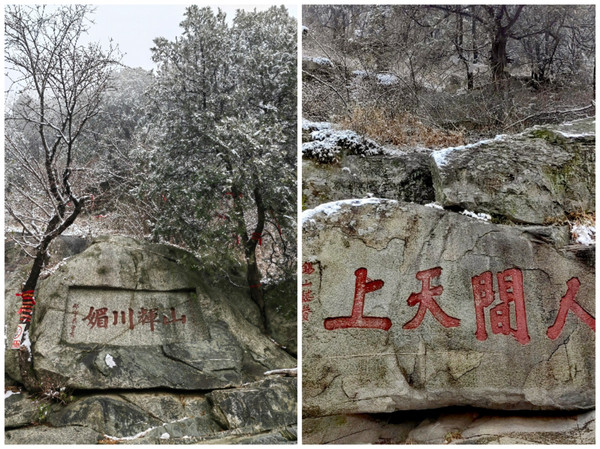
Carvings: "Shan Hui Chuan Mei" (Mountains Gleam, Rivers Charm) and "Ren Jian Tian Shang" (On Earth as in Heaven).
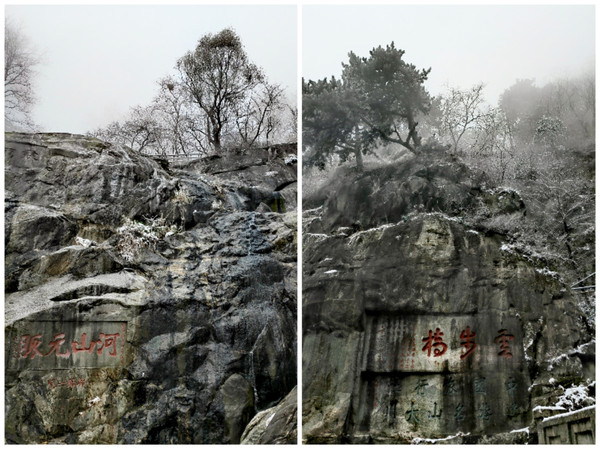
Carvings: "Jun Ling" (Steep Ridges), "Qu Jing Tong Xiao" (Winding Path to the Heavens), "Tian Xia Ming Shan Di Yi" (Number One Famous Mountain Under Heaven), and "Ruo Deng Tian Ran" (As If Climbing Naturally to Heaven). We've reached the vicinity of Cloud Step Bridge.
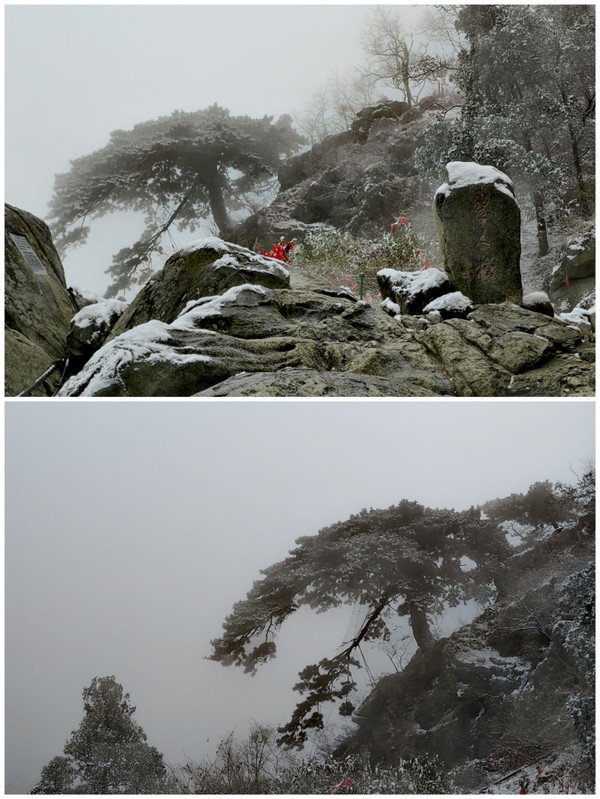
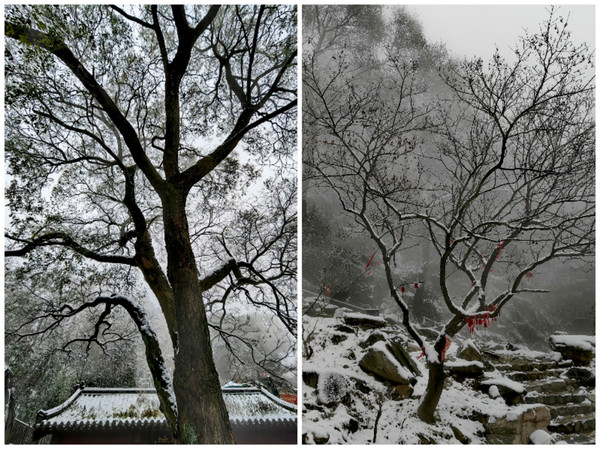
Snow-covered pines. The snow only made their gnarled, sinewy branches more striking.
"Deng Huan Xi Di" (Climbing to the Land of Joy), "Miao Ji" (Superb), "Xiao Yao You" (Wandering in Freedom).
"He Shan Yuan Mai" (Original Vein of Rivers and Mountains), "Yun Bu Qiao" (Cloud Step Bridge).
"Que Guan Wu Yue" (Truly Crowns the Five Peaks), "Fei Lai Shi" (Stone That Flew Here), "Wu Da Fu Song" (Five-Daifu Pines). According to the Records of the Grand Historian, when Qin Shi Huang climbed Mount Tai he was caught in rain and sheltered beneath a great tree; in gratitude for its protection, he awarded it the noble rank of "Five Daifu." In the Wanli era of the Ming dynasty, the ancient pine was destroyed by lightning. During the Yongzheng reign of the Qing, five pines were replanted as replacements; two survive today, their branches twisted and gnarled, ancient and rugged.
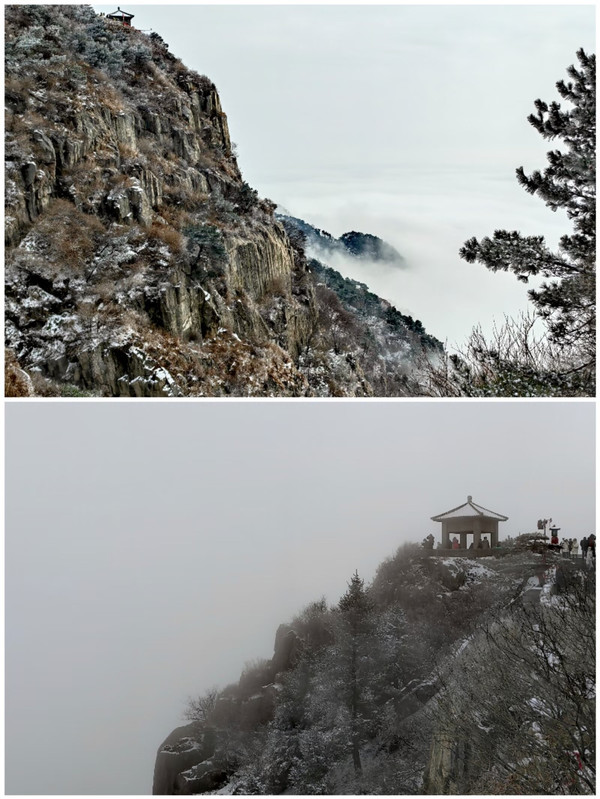
From this vantage, the distant mountains opened up vast and serene, like an ink-wash scroll.
Dongyue Temple.
Greeting Pine, also known as the Welcoming Pine. Its gnarled branches reach downward as if bowing and beckoning guests—one of Mount Tai's iconic landmarks.
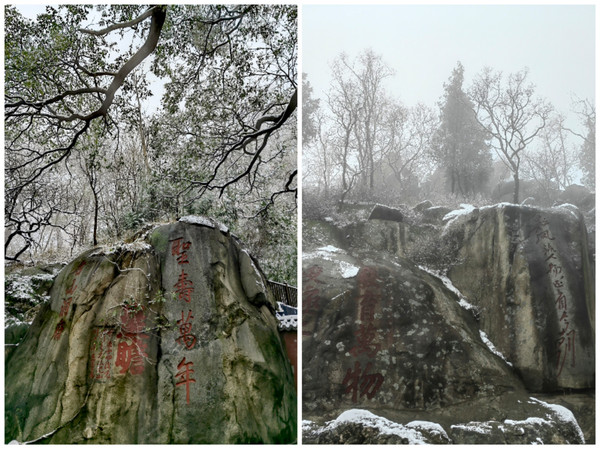
Carvings including "Sheng Shou Wan Nian" (Ten Thousand Years of Imperial Longevity) and "Shu Feng Liu Ren Wu, Hai Kan Jin Chao" (Counting the Great Figures of Our Time, Look to the Present).
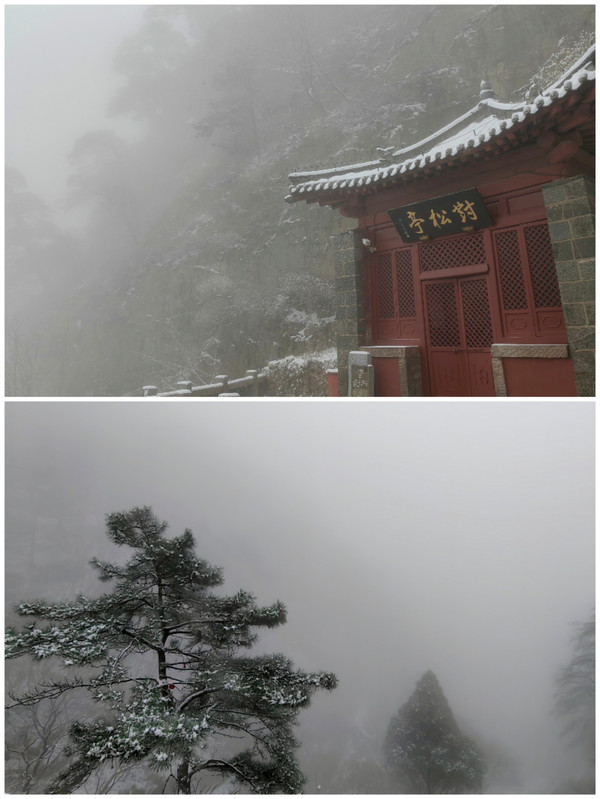
Dui Song Mountain, also called "Ten Thousand Pine Mountain." Here the path passes between two opposing cliffs thick with ancient pines, layer upon layer, in every conceivable pose—a truly spectacular sight. Li Bai of the Tang wrote, "Tall pines reach into the Milky Way; from afar they seem less than a foot." The Qianlong emperor of the Qing praised, "The finest scenery of Dai is here; Dui Song